Kent’s drought and hosepipe bans expose a messy water map
Five drinking water suppliers, disconnected supply areas and decades of mergers leave neighbouring Kent households subject to different hosepipe rules


Kent's drought and resulting hosepipe bans have exposed one of the county's strangest quirks. Two neighbours can face different restrictions despite living just a few miles apart, thanks to a patchwork of water company boundaries built up over nearly 200 years. We trace how Kent ended up with five different water suppliers, why the map makes so little sense today, and what it reveals about the way water is managed across the county.
Kent’s drought and hosepipe bans expose a messy water map
The question keeps appearing in local Facebook groups. Is there a hosepipe ban here?
The answers arrive confidently. Yes, it covers Kent. No, Southern Water has not introduced one. It only applies in certain towns. Someone posts a link to one company’s restrictions and is told, correctly or otherwise, that another company supplies the area.
Frequently, at least some of the information is wrong. This is less surprising than it sounds because there is no single answer to whether Kent has a hosepipe ban.

South East Water introduced restrictions for its Kent customers on 3 July. Thames Water subsequently imposed a ban across its supply area, including the part extending into far west Kent.
Southern Water’s restrictions apply in Hampshire and the Isle of Wight, not its Kent drinking-water areas. Affinity Water’s ban covers its central region but not the company’s separate territory around Folkestone and Dover. SES Water has activated its drought plan, but has not reached the trigger required to introduce a hosepipe ban.
All five companies supply drinking water somewhere in Kent.
Two households can therefore experience the same weather, live under the same council and be only a few miles apart, yet face different rules. The deciding factor is an invisible company boundary which may bear no relationship to the town, district or county in which they live.
Kent’s water map is absurd, but not accidental. It has accumulated over nearly two centuries, and nobody has ever started again.
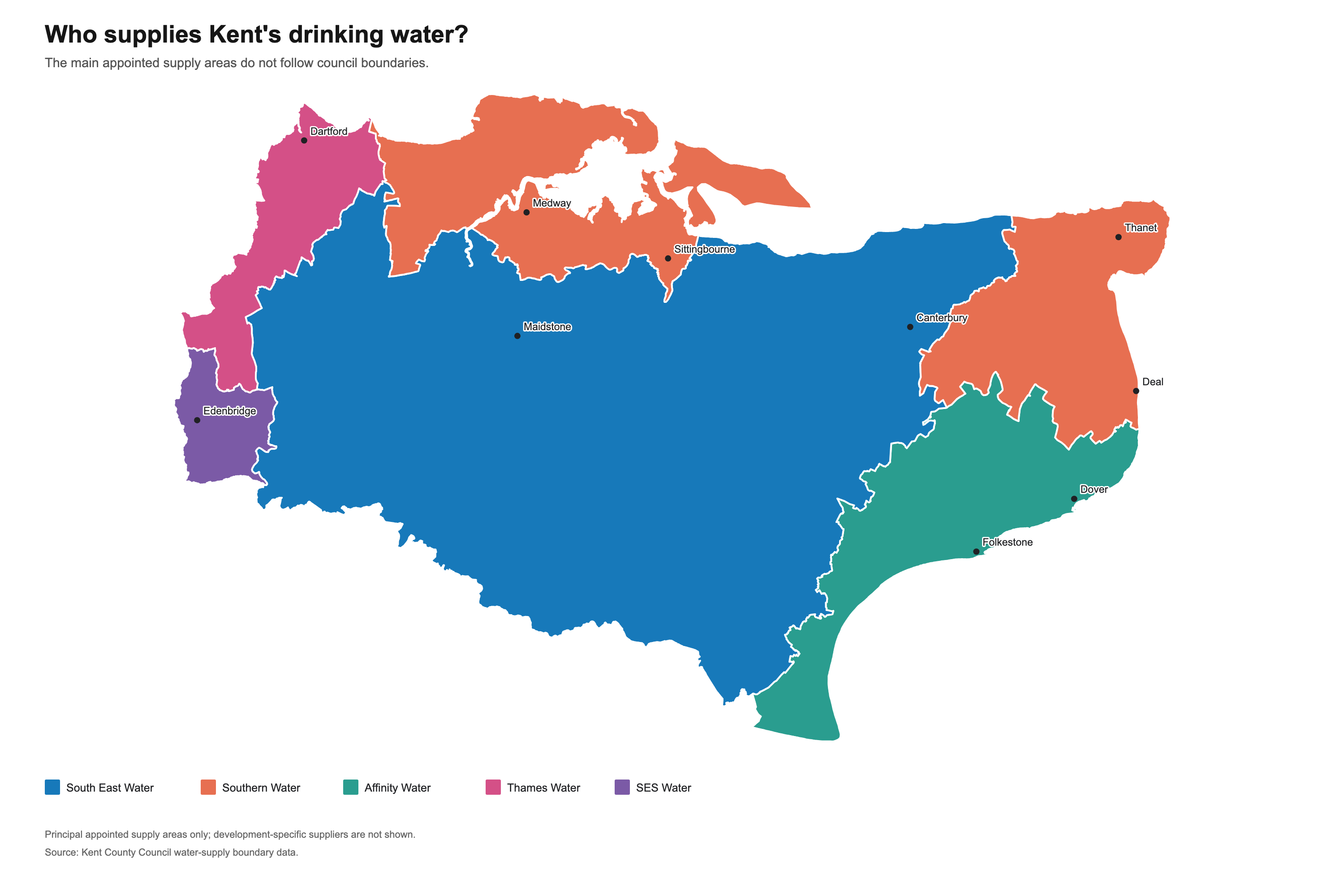
South East Water covers most of the county, but there are notable exceptions.
Thames Water reaches into Dartford from London and the Thames Valley. Southern Water supplies separate areas around Medway and Gravesham, Sittingbourne and Faversham, and Thanet and Deal. Affinity Water has a detached territory covering Folkestone, Hythe and Dover, extending across Romney Marsh. SES Water reaches a small part of western Kent around Edenbridge.
Southern Water is almost everywhere on Kent wastewater bills and only in scattered places as the drinking water supplier. In Folkestone, Affinity delivers water to the tap while Southern takes it away again.
Even the bills do not consistently present this division.
Southern Water customers receive one bill covering both drinking water and wastewater. South East Water customers also receive a single bill, but it collects Southern Water’s wastewater charges on its behalf.
The arrangement changes in areas supplied by Thames Water, Affinity Water or SES Water. Those customers receive one bill from their drinking water supplier and another from Southern Water for wastewater.
The underlying split is much the same. One company supplies the taps, and Southern takes the water away. Administratively, however, that can appear as one combined bill or two separate ones depending on which drinking-water company serves the address.
This makes the apparently straightforward advice to check the bill less useful than it sounds. A South East Water customer may see Southern Water wastewater charges within a South East Water bill. An Affinity customer may receive a separate Southern Water bill. Neither arrangement means Southern supplies the drinking water.
Hosepipe restrictions are imposed by the drinking-water company. Residents must establish who supplies the tap, rather than simply recognising a company name somewhere on their paperwork.
How did Kent’s water supply become this complicated?
Register for free to discover how vanished water boards, privatisation and new housing developments created the boundaries still deciding who can use a hosepipe today.