“The universe goes on and on. It never stops”
What we asked Anton Vamplew, astronomer and creator of the Night Sky Club
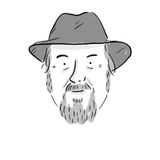

Anton Vamplew first appeared on Blue Peter in 1997 as the programme's resident astronomer, but long before that he was known to Radio Kent listeners as Captain Cosmos. Steven met him to discuss a lifetime spent explaining the night sky, why Pluto is still a planet in his eyes, and why August could provide one of the best evenings for stargazing in years.

"I used to do astronomy on Radio Kent, where I was Captain Cosmos." During the era of Pat Marsh, Anton would present segments on the night sky before signing off with: "I'll disappear up into space, because I'm quite busy up there."
Born in Rainham, Anton's family had moved from St Mary's Cray into North Kent. His mother worked at CAV in Gillingham before starting her own interior design business, while his father worked for British Steel.
Anton’s fascination with astronomy began in childhood. “I was used to gazing out to the nighttime sky from our house when I was five and thinking, what is that?” He began learning about constellations and became even more fascinated after finding Patrick Moore’s Boys Book of Astronomy at a jumble sale in 1976.
“Not ‘Girl’s Book…’ Girls couldn't have this. The girls had a book of ballet.”
He later studied astronomy as a GCE at MidKent College. “It involved lots of coursework, following the moon over the course of the month and using a telescope to look at objects and draw them.”
The course proved more important to Anton’s future than his first job. “What was I doing? I was entering computer data for a paper company in Croydon”
What fascinated Anton was the scale of it all: “that the universe goes on and on. It never stops.” Astronomy has also changed dramatically since he first looked through a telescope. “Now we're doing infrared, ultraviolet, X-rays. In the olden days, you could only look with your eye and get visual light.”
Anton is less certain how to describe his current occupation. “I've been doing art and design for a while,” he says. That began with his first book in the mid-2000s, Simple Stargazing. “I did all the illustrations and designs for that.” He also worked at the Royal Observatory in Greenwich. “I used to teach astronomy there.”
He is now trying to return more fully to astronomy, “doing a few more talks and getting astronomy out there,” while acknowledging that “if it earns some money, that would be great.” As he approaches retirement, his main focus is simply encouraging more people to look up.
Anton's route into broadcasting began with the Mid Kent Astronomical Society, which he joined in 1979 aged 13 when it was based in Strood, before it later moved to MidKent College near Rochester Airport. Through the society, he was invited onto Radio Kent during the 1980s to talk about Halley's Comet.
“I asked one of the producers at Radio Kent, ‘Would you like a regular contributor on astronomy? If there was anything to see in the sky?’ And they replied, ‘That'd be great.’”
Working on Pat Marsh's programme led to another presenter commissioning a series of ten-minute astronomy features. “It wasn't a lot of money. About £15.”
Around the same time, Anton's wife was working for the BBC World Service on a youth programme called Megamix.
She passed one of Anton's tapes to the production team, who invited him to audition as a presenter, writing, interviewing and presenting features. He got the job.
Within a few months, Blue Peter wanted to make an astronomy feature but, as Anton puts it, “they didn't know anybody.”
In November 1997, Anton presented his first Blue Peter feature alongside Katy Hill in the Blue Peter Garden at Television Centre. “We talked about telescopes and how you could see things that are in the nighttime sky.”
Afterwards, the programme's editor approached him with an offer. “I'd like to make you the Blue Peter astronomer.”
The role involved around six features a year. Sometimes Anton would explain what children could see in the night sky. “We used to have the Cosmic Couch.”
Over the next seven years he filmed everywhere from Jodrell Bank and Isaac Newton's Woolsthorpe Manor to the Canary Islands and Hawaii.
The sacrifices. “Oh, to get paid to go to Hawaii. It was all economy class. It was still on a BBC budget.”
Blue Peter also led to Anton's first book deal with HarperCollins and a role at the Royal Observatory.
“I wrote to the Royal Observatory and said, ‘I'm on Blue Peter, can I come and work for you?’”
They said yes.
Anton believes astronomy can be exciting “if you get it right”, but “dull if you're not the right person.” He enjoyed presenting it and believes he “did it well.”
After years talking about the night sky on television and radio, Anton stepped away to focus on other work. “You only have a certain amount of time. I was still watching the stars, but I wasn't doing anything beyond that.”
Astronomy never stopped being his passion, though. It eventually drew him back through books, public talks and, most recently, the Night Sky Club.
Create your free account to keep reading.
Continue with Anton's guide to August's eclipse and meteor shower, his memories of Blue Peter and Radio Kent, and why he's on a mission to get more people looking up at the night sky. It only takes a moment to register.