DOLGE is dead. Long live DOLGE.
KCC replaces its flagship efficiency department with a council-wide way of working with no savings target, no new powers and closed meetings at the centre

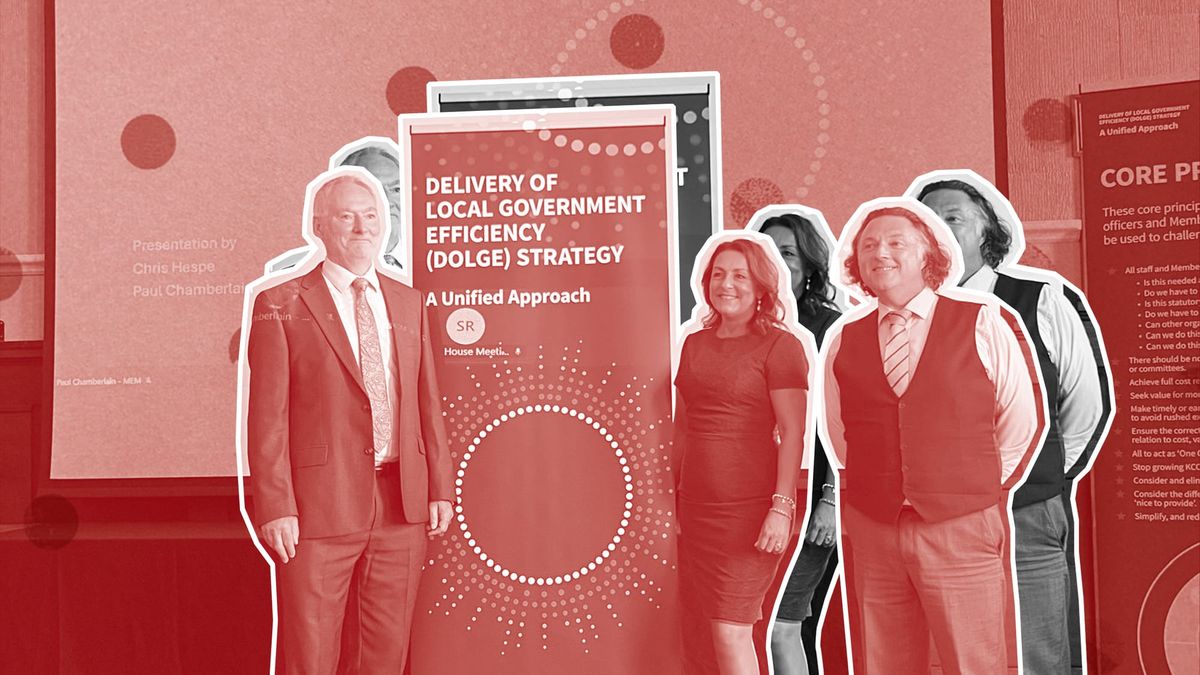
Reform's flagship DOLGE project has undergone a transformation. The Department of Local Government Efficiency is gone, replaced by a new strategy carrying the same acronym but a very different approach. We examine why Kent County Council has changed course, what the new version is supposed to achieve, and whether it amounts to a meaningful shift or simply a new label for existing work.
DOLGE is dead. Long live DOLGE.
Kent County Council leader Linden Kemkaran remembers taking control of the authority as finding herself “in the driver’s seat of a runaway train.”
Long-term debt stood above £730m, daily interest payments exceeded £80,000, and spending on services including adult social care was moving out of control.
“I knew I had to locate the brake lever and pull it hard, but without derailing the carriages behind me,” she told journalists gathered at County Hall on Thursday.
Reform’s answer was DOLGE, the Department of Local Government Efficiency. The name was deliberately inspired by Elon Musk’s DOGE project in the United States, although Kemkaran insisted the Kent version was more restrained.
“We’re British, and we don’t approach things in exactly the same way as our friends across the Atlantic,” she said.
Kent’s version would be “subtle, focused, quietly observant, but quick to act when necessary.”
Just over a year later, the Department of Local Government Efficiency no longer exists.
In its place is the Delivery of Local Government Efficiency, retaining the acronym while replacing the small, member-led operation with a strategy intended to run through every part of KCC.
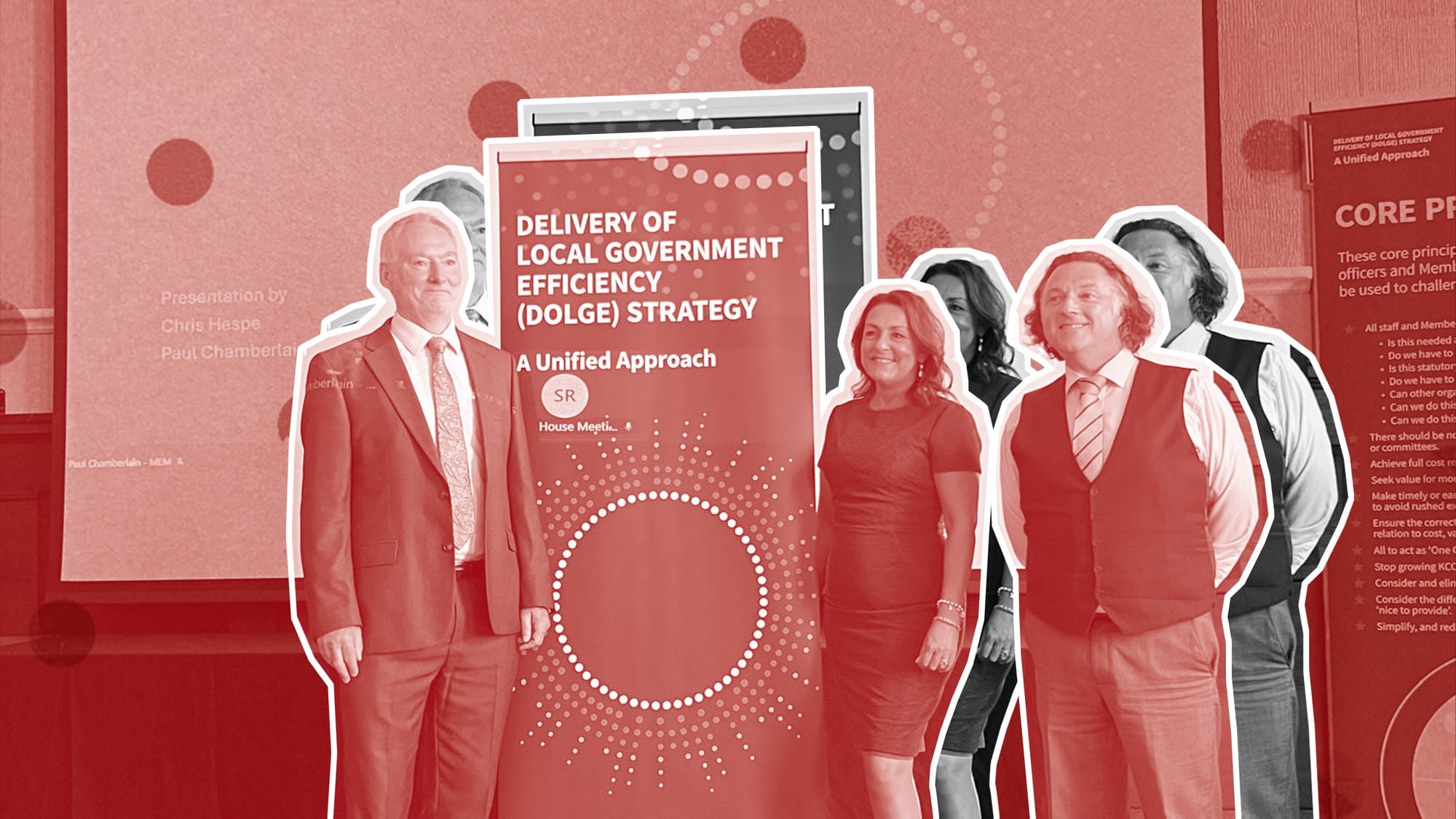
The new version is broader, more collaborative and harder to define. Its work will largely be performed by council officers through existing financial and performance systems, with Cllr Chris Hespe and his deputy, Cllr Paul Chamberlain, remaining as the political DOLGE team overseeing it.
DOLGE, in other words, is no longer really a department. It is closer to a state of mind.
The launch began with a video celebrating DOLGE’s first year, followed by slightly awkward applause from the Reform councillors gathered in the room.
Kemkaran insisted the project had been an “unmitigated success” and was “very much alive and kicking,” pausing to take a swipe at KentOnline for reporting otherwise.
Hespe then attempted to establish agreement around the project by asking anyone in the room who did not believe KCC should spend money wisely, seek savings or obtain value for money to raise their hand.
Nobody did, delivering the expected consensus that wasting public money is bad.
“Well, DOLGE is about all of the above,” Hespe concluded.
He insisted this was now “a KCC strategy, not a Reform UK strategy”, endorsed by the chief executive, the council’s senior finance officer and the corporate management team.
“All spend and savings work in KCC will have the DOLGE watermark running through it,” he said.
For a strategy built around making systems work more efficiently, the presentation had its moments. A slide setting out DOLGE’s first-year actions initially failed to appear, leaving Hespe waiting before the technical problem was resolved. The strategy itself was described as launched and live, although the published document still labels itself 'First edition – September 2026.'
The original DOLGE was created after Reform took control of KCC in May 2025. It was intended to bring a new set of political eyes to a budget written by the previous Conservative administration.
Its members promised to leave no stone unturned, interrogating every budget line for waste and monitoring whether planned savings were being delivered.
Alongside it came a separate intervention from Reform’s national DOGE operation. Then-party chairman Zia Yusuf announced that a team of “world-class software engineers, data analysts and forensic auditors” would arrive at County Hall to examine the council’s records.
Our account of Musk-style politics arriving in Kent recorded Yusuf appearing at KCC with Brexit backer Arron Banks and software developer Nathaniel Fried. Within days, Yusuf had resigned as Reform chairman and Fried had departed with him.
The national circus quickly moved on, but the local acronym survived.
The difficulty was that KCC’s finances did not contain the vast pool of easy savings the rhetoric implied.
DOLGE has changed its name, but the harder questions start here. Register for free to examine KCC’s savings claims, why the new version has no specific target or additional powers, and how its closed-door “star chambers” will work.
By the time Reform produced its first KCC budget, the numbers described a council managing a narrowing margin for error after years of restraint. Its largest pressures came from adult social care, special educational needs and other statutory services where demand could not simply be switched off.
That tension eventually broke into public view when DOLGE’s original Cabinet member, Cllr Matthew Fraser-Moat, told the Financial Times that the administration had not actually made any cuts. He resigned shortly afterwards, describing the conversation as a “lapse of judgement” and saying his words had been twisted.
Cllr Chris Hespe replaced him, although he made a point of thanking Fraser-Moat at Thursday’s launch for laying DOLGE’s foundations.
KCC credits the first phase with helping the authority deliver around £100m of savings, avoid £39.5m in future spending and reduce long-term debt by £114m during the financial year. Hespe said the total debt reduction since Reform took office had now reached £142m.
Those figures describe several different things.
The savings target was inherited from the previous administration, and much of DOLGE’s stated role involved monitoring whether directorates delivered it. The £39.5m relates to future spending that KCC says it avoided, rather than cash removed from the existing budget.
The council’s final finance report recorded £98.6m in delivered savings and additional income. It also showed KCC ending the year £22.7m over budget, with the gap again covered from reserves.
That apparent contradiction was the point of our examination of KCC’s year-end finances. The council can find substantial savings while still being overtaken by the rising cost of services it has a legal duty to provide.
The new DOLGE is an acknowledgement of that more complicated reality.
“Now that the administration has set our own budget, we enter the second phase of DOLGE,” Hespe said.
“It would be surprising if we found massive waste in the budget that we had set.”
The original version was sold as a disruptive group searching for waste. Its replacement seeks to make every directorate responsible for efficiency instead.
Cllr Paul Chamberlain said the strategy provides a common destination for the organisation.
“Everyone here now knows where we’re going,” he said. “They know why we behave the way we do, or why we do the things we do.”
Asked by Kent Current whether the new strategy had an overall savings target, Hespe was unequivocal.
“No, we do not have specific targets,” he said.
He argued that setting one would mean KCC had effectively decided in advance how far services or staffing should be reduced.
“It would be inappropriate to do that because that means that we’ve already made decisions on what we should be slimming down,” he said.
“We would get in a right pickle if we were saying we have to take X number of staff out, we have to take these services out. It would just be the wrong approach completely.”
Hespe insisted the programme was not about cuts.
“This isn’t a game about cutting things, either chopping things off or salami slicing,” he said.
Instead, KCC will consider different ways of delivering services. Hespe listed externalisation, management contracting, partnerships and divestment among the available options.
“Just trying to find sensible ways in which we can do things better is a far better approach,” Hespe told us.
Asked whether embedding DOLGE across KCC gave it greater power to implement changes, he was equally direct.
“It doesn’t change our power,” he said.
What changes, according to Hespe, is the likelihood of the political leadership’s intentions being carried out.
“Officers understand it, officers endorse it,” he said. “This has been endorsed by the chief executive, the Section 151 officer, the corporate management team. They’re all fully behind this.”
That leaves the new DOLGE in a curious position. Its remit extends across the authority, but there is no separate officer delivery unit and the strategy identifies no additional resources for the work. Hespe and Chamberlain remain the political team, while officers and directorates are expected to deliver the substance.
Even the strategy’s own analysis acknowledges the problem.
“DOLGE typically relies on other departments to implement changes,” it says. “Savings and improvements can be claimed but not realised.”
The strategy does contain a long list of things KCC wants to do differently.
The council will make greater use of unit costs, examining how much a service costs for each person using it rather than relying solely on large overall budgets.
It plans closer account management of major suppliers, earlier commercial involvement in purchasing decisions and new measures of procurement savings.
Staff logging into their computers are already being prompted to submit ideas that could save money or generate income. Successful suggestions can receive a £500 cash reward.
The council will also develop what it calls “oven-ready options” that can be introduced quickly if monthly financial reports show a budget moving off course.
These could sit alongside “pre-cooked options”, including recruitment freezes, limits on external conferences and other immediate spending controls.
Cllr Mark Hood, leader of the Green Group on the council, spotted a theme. With “oven-ready options”, “pre-cooked options” and spending freezes all appearing in the strategy, he said, “the only thing missing is an acknowledgement that this whole enterprise is half-baked.”
Beneath the culinary criticism was a broader argument. Hood said the new strategy “seems to revolve around individual directorates taking a tighter control on their budgets,” raising the question of what they had been doing during Reform’s first year.
KCC’s answer is that the work may use familiar council machinery, but DOLGE brings it together under a common strategy with political backing. Hespe said other authorities had sought advice about its approach and that DOLGE was being recognised as an example of “good practice.”
More significantly, the strategy asks KCC to examine the difference between statutory services, discretionary services and “acceptable minimum levels of provision”.
Its core principles tell staff and members to ask whether spending is necessary, whether KCC must provide the service, whether another organisation could do it and whether only part of it is required.
Another principle is blunter.
“Stop growing KCC.”
Chamberlain said that reflected the approach of local government reorganisation, which will replace KCC, Medway Council and Kent’s 12 district authorities with four new unitary councils in April 2028.
“Organisations love to grow,” he said. “The good idea becomes a department, becomes a budget line.” KCC would instead be handed over “as is.”
Hespe said there were no current plans to cut jobs, although natural wastage was possible as reorganisation approached. He also declined to promise that DOLGE would mean lower council tax, saying the next increase would not be decided until the February 2027 budget process.
At the centre of the new monitoring system will be a series of “star chambers” for council directorates.
These will bring together DOLGE members, finance staff and senior officers to examine whether spending and savings are on track and identify emerging problems.
Hespe described them as informal internal meetings. They will not be open to the public and will not follow a regular published schedule, instead taking place when considered necessary.
Calling an informal meeting held behind closed doors a “star chamber” is at least admirably on the nose.
The term has a long second life in government as jargon for forceful budget-review panels. Its historical namesake was a court operating through the King’s Council that was abolished in 1641 following complaints about its practices.
KCC’s public explanation of the strategy promises to be “open and clear”, regularly reporting what has been achieved.
It does not say whether the star chambers will produce public records showing what was proposed, which interventions were requested or how much they were expected to save.
When the Kent Current asked Hespe what formal scrutiny or outputs would follow from decisions made informally, he said there was “plenty of scrutiny” and directed us to the strategy’s monitoring section.
That section says DOLGE will draw on KCC’s existing finance, performance and strategy reports. None provides a dedicated public record of what happens inside a star chamber, despite those meetings being described as the cornerstone of DOLGE’s monitoring.
All of this will operate under the approaching abolition of KCC.
Hespe said the council had around 20 months of existence remaining, but argued that choices made during that period could shape Kent’s services for another ten or twenty years.
Reorganisation already affects decisions over long-term contracts, renewals and their cut-off dates. Hespe also sees it as an opportunity.
“It’s actually a big opportunity for us to rationalise, and decide how we can divest, how we can disaggregate services in the best way for the public of Kent,” he said.
He believes the four successor councils may eventually adopt much of the DOLGE strategy, or at least its underlying principles.
There is an unresolved democratic question within that ambition. KCC must keep services functioning and prepare them for transfer, but the more it reshapes, contracts out or divests before 2028, the more it determines the inheritance of councils that do not yet exist.
The strategy itself appears not to have entirely caught up with events. Published two weeks after the government selected the four-unitary model, it still discusses what will happen “should the government decide to proceed” with abolishing Kent’s existing councils.
The new DOLGE may prove more realistic than the project Reform launched last year. It accepts that efficiency cannot depend on a few councillors discovering spectacular waste and instead places responsibility throughout an organisation managing genuine financial pressure.
It is also harder to judge. There is no headline number against which it expects to be measured, and its most important challenge meetings will take place away from public view.
The department is gone. The acronym remains. Whether the new version delivers anything distinct will depend on what happens inside KCC, and how much the authority eventually chooses to tell the people paying for it.
Footnotes
Have a Kent story you think we might be interested in? Get in touch via hello(at)kentcurrent(dot)news - We’re always happy to talk off the record in the first instance…
Follow us elsewhere: Facebook, Instagram, BlueSky, and now WhatsApp for new story alerts.