“Embrace your inner oddball”
What we asked Oliver Double, Reader in Comic and Popular Performance at the University of Kent


Reading about the British Stand-Up Comedy Archive in Robin Ince's memoir, Steven was curious to find out more. Thankfully, Oliver Double, Reader in Comic and Popular Performance, was happy to host Steven in his office at the University of Kent, where they discussed how the archive started, why Kent isn't known for original comedy and whether stand-up is a form of theatre.

What is your official occupation?
I am Reader in Comic and Popular Performance at the University of Kent. Which is a weird job title, I am aware of that.
Do you have any additional roles, paid or unpaid?
Well, I stopped being on the circuit for comedy in 1999, but I've never really stopped. I'm the compere for Funny Rabbit, a monthly night at the Gulbenkian. I do a few gigs a year. In addition, I co-host a podcast with Laura Lexx called The Comedy Bureau. Laura is a comedian who started doing stand-up when she was studying here. I taught her when she was studying here.
How did that podcast start?
Laura WhatsApp’ed me and said, “I've got this idea for a podcast. It's me and you get really nerdy about comedy.” It took me a second. “The answer is yes.” The second series just finished. We've got a whole other series already recorded.
What is your relationship to the British Stand-Up Comedy Archive?
I essentially founded the archive because in 2013, my friend Warren Lakin contacted me. He was Linda Smith's partner, saying “I'm moving house, I've got all this stuff from Linda. Would you like it at the university, because she grew up in Kent.” I said, “That sounds great. I need to check with my colleagues.” A former colleague who was at the time in charge of our Special Collections and Archives department was very interested in the British Cartoon Archive, which we've had here since the 1970s. He feared that, maybe because newspapers are, in the traditional way, phasing out, perhaps the cartoonist might be a dying breed, which I think was an unfounded fear, but he said “Maybe we should try and use this as the beginning of an archive,” and I said “That sounds like a great idea, but I really need to check with some people I know because sometimes comedians can be very protective.” I asked two comedians that I know, Mark Thomas and Josie Long and said to them you “We've started an archive. Would you be prepared to donate?” and they both said yes. In fact, Mark came back to us very quickly with a ton of stuff.
Warren had been on radio, because Linda was obviously a big figure on Radio 4 and there'd been an anniversary, and she was back in the news after dying. He announced that we were starting this archive, and it was before we'd had official approval or anything. But now the news was out there in the world. That was 2013.
You can't put stand-up itself into an archive because it's a live performance form
Linda is someone I would have loved to have interviewed. For the readers who might not have been aware of her, how would you describe her and her comedy?
Linda Smith was a working-class comedian from Kent who was very political and very sharp, a really good stand-up comic. She did bits of telly, she was on Room 101 with Paul Merton, for example. Some QIs and Mock the Weeks early on. Where she really found her audience was Radio 4. She was a regular on the News Quiz, and she was an absolute stalwart of that. She was brilliant on it. And she also did things like I'm Sorry, I Haven't a Clue. Her own show, called A Brief History of Time Wasting, for radio. She was brilliant, a really nice person, and I think when she died, perhaps the full extent of people's affection for her was really expressed. Warren, who sadly died himself earlier this year, was really good at curating Linda's legacy. He put out two books, one of her work, transcripts of her performance. Then the other was a memoir about her. He also curated a series of Loving Linda benefit gigs for Target Ovarian Cancer.
What does the archive do? Is it something that the public can view?
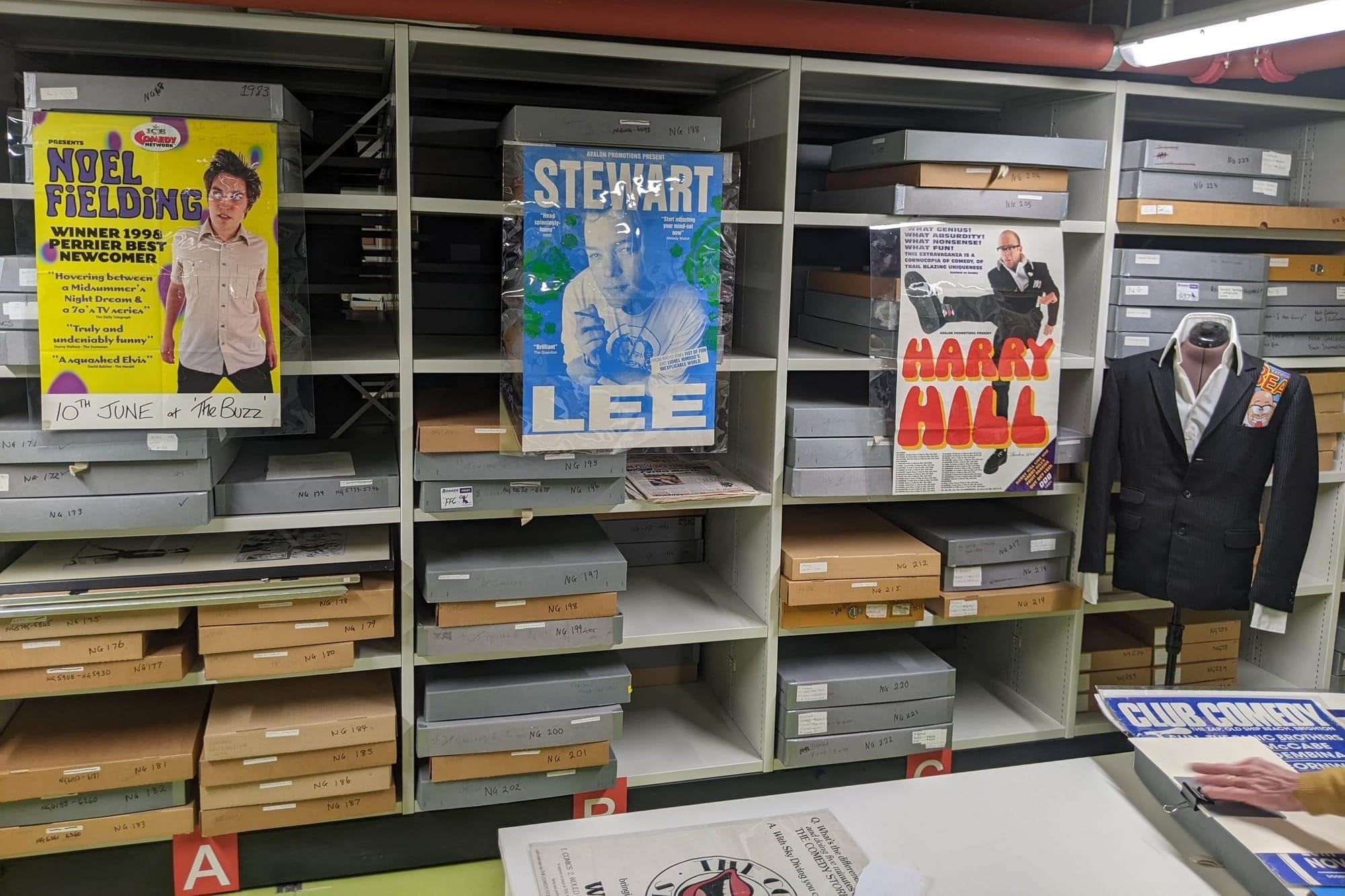
It collects material connected with stand-up comedy. In terms of whether the public can access it, you absolutely can. If you want to see any of the material, there's an online catalogue, and you can arrange to come in and see the material. You give an indication of what you want, and they'll fetch it up from the stacks where it's stored, and they'll take it to the reading room, and you can spend as long as you like with that.
Here's the weird thing about stand-up. You can't put stand-up itself into an archive because it's a live performance form, and even if you did a gig in the archive, when the gig finished, it's not in the archive anymore. What you could put in there is a bunch of stuff that relates to that, so it's really varied. A leatherised tangerine is one of the first things that was donated to the archive by Josie Long. Josie Long threw this orange into the audience of the 2008 Trying is Good show, Melbourne. Josie did a show about museums and archiving. People send her items, and that was one of the things that was sent. She used to do a thing where she used to reward punters for trying hard. She would give them an orange. You might say, what's that got to do with stand-up? I think it's got a lot to do with stand-up because I think it's a really interesting symptom of Josie's approach to comedy, which is very earnest, enthusiastic and DIY. A lot of stand-ups could be much more abrasive than that, but that's not her style. She's quite nerdy. I think it is encapsulated by that orange. It was given out to somebody as a reward for trying hard, which indicates something about her performance style. A show about museums and archiving that tells you a lot about her performance style. It tells you a lot about her fans and the dedication of her fans, the fact they kept the orange and then sent it to her. Although you'd think it would have gone mouldy or rotted, it hasn't. It's just desiccated. Hopefully it'll last forever.
The items we have, we've defined stand-up quite broadly. We've got stuff that was donated to us by Attila the Stockbroker, the ranting poet, who definitely doesn't see himself as stand-up. He's quite anti stand-up in a way, but ranting poetry was one of the roots of modern stand-up. Also, he studied here. Why wouldn't we want to honour him in that way? We've got things to do with sitcoms, radio, and TV that grows out of stand-up. Scripts that were donated by Alexei Sayle, for example. We've got business records, we've got fan collections, we've got obviously a lot of publicity materials, we've got a lot of recordings, video and audio, both things that have been broadcast or made commercially available and things that haven't. Privately made recordings. We've also got one of Harry Hill's suits, props, weird items. It's a really, really varied collection.