Kent’s cup finals week goes from showcase to shambles
Disorder overshadows two finals as complaints surge at County Hall and Reform drifts back into AI slop


Kent’s county cup finals week has been overshadowed by disorder, public statements and investigations after incidents across two separate finals. We also look at the sharp rise in complaints against KCC councillors and fresh questions over Reform councillors sharing council-branded political graphics.
Kent’s county cup finals week turns into an avoidable embarrassment
Kent’s county cup finals week should have been about the football.
Whitstable Town completed a league and cup double on Sunday. Maidstone United won the Kent Senior Cup on Wednesday night. There was silverware, big crowds and the sort of end-of-season occasion county finals are supposed to provide.
Instead, both finals have ended up overshadowed by what happened around them.
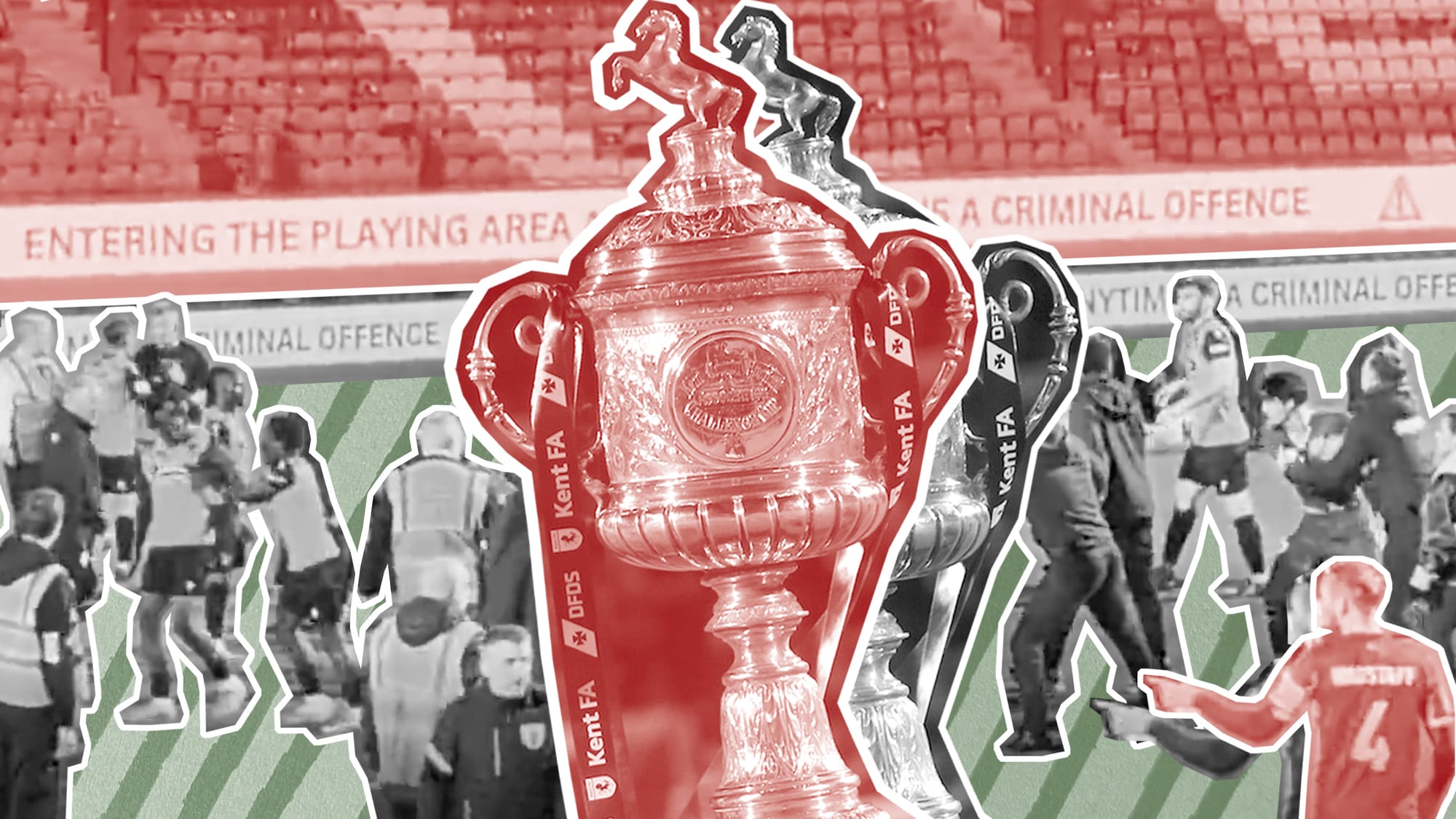
Whitstable’s 2-0 win over Punjab United in the Kent Senior Trophy final at Maidstone United’s Gallagher Stadium ought to have been the straightforward one. Nearly 1,500 people were there to watch it, and Whitstable finished off a memorable season with another trophy.
But the match has since been dragged into a serious public dispute over disorder in and around the stands.
Gravesend's Punjab United issued a statement following the match saying its supporters, “the majority of whom were families and young people,” were subjected to repeated verbal abuse after “a large number of opposing supporters entered and occupied the same stand” during the game. The club said that it included “chanting of a racist nature.”
Punjab also said that after the final whistle, drinks were thrown towards its section, provocation continued, and physical confrontations broke out near families and children. It said players and coaching staff felt they had to intervene because of what it described as a limited security presence in the area.
Those are serious allegations to be making after a county cup final. They are not the usual complaints after a heated game or a bad defeat. They go to supporter safety, stewarding and whether people who had turned up to watch a final, including children, were properly protected when things started to unravel.
Whitstable has not dismissed the issue, but it is very clearly contesting Punjab’s account.
In its own statement, the club said it deliberately held off on making any immediate public comment until it had reviewed footage and information related to the incident. It said it had “not identified evidence that enables it to reach a finding of racist intent” and would wait for the findings of the relevant authorities before drawing any final conclusions on that point.
Whitstable said racism has no place at the club or in football, but also said it did “not accept” Punjab’s statement as “a full and accurate reflection of the events that unfolded.” Its position is that there was an altercation involving “a very small number of individuals connected to both clubs’ supporters,” which was then intensified by the involvement of additional individuals from the pitch.
The two clubs are not just putting slightly different spins on the same thing. They are describing the same final in sharply different terms.
Kent FA has at least acknowledged the seriousness of the claims. The county body said it was “disappointed” by the incidents after the final whistle and was treating the matter seriously. It said it was working with the host club, the event security team, both finalist clubs and Kent Police to understand the circumstances and would review its processes for future events.
That would have been enough to leave Kent football with one ugly cup final on its hands.
Then the other final finished badly too.
Maidstone beat Tonbridge Angels 2-0 at Priestfield on Wednesday night to win the Kent Senior Cup for the 20th time.
The story instead became about a match that ended with a confrontation involving players and staff from both sides after the final whistle.
Kent FA said it was “deeply disappointed” by the incidents following the conclusion of the final and was investigating the disorder, including damage to Kent FA property. It said it was working with both clubs and Kent Police and that appropriate action would be taken.
Videos of the brawl are circulating on social media, so this is not one of those vague incidents that exist only in carefully worded statements afterwards. Something clearly kicked off.
Beyond that, the picture is less tidy. There has been outside reporting on what triggered the clash and how it escalated. The Back Page, an independent Maidstone United fanzine, painted the final stages as increasingly ill-tempered and described a “massed scrum” that delayed the trophy presentation.
The two finals are not the same story.
The Whitstable-Punjab fallout is plainly the heavier one. It involves allegations of racist chanting, questions over segregation and stewarding, and claims that families and children were caught up in the disorder. Those claims are disputed, and it will be for the relevant authorities to establish exactly what happened. But the fact that a club is making allegations like that after a county final is serious enough on its own.
The Maidstone-Tonbridge final looks, on the face of it, more like a bad-tempered game boiling over at the end and dragging players and staff into it. That is bad enough, especially with Kent FA talking about property damage as well as disorder, but it is not the same kind of issue.
Even so, taken together, it is still a grim look.
County finals are supposed to be a part of the local game that can be presented without too much qualification. Big occasion, good turnout, bit of silverware, everyone goes home. Instead, this week has produced investigations, public statements and the sort of questions nobody wants hanging over two showpiece fixtures.
That is especially true of the Senior Trophy final. Once a club publicly says its supporters were subjected to racist chanting and that families and children were caught up in the aftermath, the conversation moves well beyond whether a few idiots got out of hand. Whitstable disputes that picture, but Kent FA’s own line about reviewing processes suggests there are broader questions here than simply whether some people behaved appallingly.
On the Senior Cup side, the overall picture may be less serious, but it is still embarrassing. A county final ending with a brawl, property damage and a delayed trophy presentation is not much of an advert for anyone involved, however much Maidstone will still quite rightly take the trophy.
The frustrating part is that both finals had perfectly decent football stories of their own.
Whitstable completing a league and cup double is a real achievement. Maidstone lifting the Kent Senior Cup for the 20th time is a huge achievement. Both should have been enough.
Instead, both have been shoved aside by what happened afterwards.
Proving that none of this was somehow inevitable, Kent’s women’s finals seem to have managed perfectly well. Maidstone won the Kent Women’s Plate last week. Dartford won the Kent Women’s Cup on Thursday. Both appear to have gone off without anyone ending up in a public row afterwards.
A reminder, if one were needed, that Kent’s finals week did not have to end like this.
Complaints against KCC councillors have gone from a trickle to a flood
Something has clearly gone wrong at County Hall. Complaints against Kent county councillors, once a fairly marginal part of council life, are now piling up in batches. New papers for next week’s Standards Committee show 85 complaints were received in 11 months, with member-on-member complaints forming an increasingly large share of the total.
That is a dramatic break from recent years. KCC’s own reports show eight member complaints in 2020/21, nine in 2021/22, two in 2022/23, and one complaint responded to in 2023/24. Even an increase in 2024/25 only resulted in 13 complaints.
The council says 81 of the 85 complaints in the past year have already been closed or resolved informally, with four still under review. It does not formally code complaints by subject, but says the main recurring flashpoints are social media comments, behaviour and remarks during formal meetings, and the use of council resources.
The breakdown gets worse. Across the full period, 40% of complaints came from councillors complaining about other councillors. In the first three months of 2026, that rose to 72%. In March alone, 14 of the 16 complaints came from members.
KCC does not publish the figures by party, so the papers do not formally tell the public who is behind the surge. Even so, the timing is doing plenty of work, and opposition group leaders are in little doubt that standards at County Hall have deteriorated sharply.
Cllr Mark Hood, the leader of the Green group, said he had “completely lost faith in the council’s response to complaints about councillor conduct” and argued that “member behaviour has deteriorated” under the current administration. Labour leader Alister Brady was similarly blunt, calling the increase “wholly unacceptable” and saying standards at KCC had “taken a nosedive since the Reform administration became the decision makers.”
Both men argued that the tone from the top had worsened matters. Hood said “the divisive tone has been set by the leader” and warned that “if members cannot behave, we will see our democracy dragged into the gutter.” Brady said previous councillors “knew how to disagree well,” but that the current leadership had set a worse example and that “the facts speak for themselves.”
Cllr Harry Rayner, the Conservative leader, put a slightly different emphasis on the same broader problem. He said the rise reflected not just a more toxic atmosphere at County Hall, but also the inexperience of a large intake of new councillors. He argued there had been a rise in “tit for tat” complaints over slights that might once have been dealt with informally, and said older back channels between groups had been shut down. In his view, “intolerance breeds intolerance.”
KCC told the Kent Current that they had nothing further to add beyond what was in the report.
The papers also suggest KCC knows this is no longer a small problem. They note that a new Independent Person started in March, with plans to recruit a second as well. The role is meant to provide advice and, in the council’s words, “most importantly objectivity” while complaints are being handled.
The papers do not indicate how many complaints were upheld, and a single alleged breach can generate multiple complaints from multiple people. But even allowing for that, this is not a normal level of internal friction. Complaints that used to sit in single figures are now arriving by the dozen, and councillors are increasingly using the formal system against each other. County Hall has plainly become a nastier place to do politics.
Kent is large, messy and often faintly absurd. The Kent Current is backed by readers, which means we can report on it properly. An annual subscription costs £1.15 a week and helps make that possible.
More adventures in AI slop
A social media graphic being shared by Reform councillors in Kent is raising fresh questions about the party’s use of council-adjacent branding in political messaging.
The image claims Kent County Council has 'reduced debt by £114m' and is now saving '£3,362 in daily interest' while doing so 'without any cuts to vital services.' It is being shared by Reform councillors rather than through official KCC channels, but it uses an AI-generated crest and a design style plainly intended to echo the council's visual identity.

No one is likely to look at it and conclude it is a genuine piece of council communication. It has the unmistakable look of cheap AI slop. But that is not really the point.
The issue is that Reform councillors are once again using imagery clearly intended to evoke Kent County Council to push a party political message.
Asked about the graphic, Kent County Council told the Kent Current: “The information in the infographic is correct but it is not a KCC-produced communication.”
We then asked KCC whether it had given permission for its branding, or something clearly intended to resemble it, to be used in the image, whether it considered that appropriate, and what guidance applies to members using council-style branding in political material. No further response was received.
That leaves the council in an awkward position. It was willing to authenticate the numbers, but not to say much about councillors borrowing the look of the institution itself in order to present them.
The image also carries no imprint identifying who produced or promoted it.
The broader issue here is not whether this particular image is persuasive, or whether anyone would really confuse it for the work of a competent council communications team. It is that political figures are again helping themselves to the symbols and styling of the authority when it suits them.
In Kent, there is also a recent history. During last year’s county council election campaign, Reform had to withdraw leaflets after complaints over their use of the KCC logo. Less than a year on, Reform councillors are again circulating material that leans on the council’s identity while pushing a party message.
If Reform wants to claim credit for debt reduction, it is perfectly entitled to do so. That is politics. But it should do so openly as a political party, under its own name and branding, rather than wrapping the message in fake-official AI sludge and leaving basic questions unanswered.
Instead, what remains is a party political message that wanted the council’s authority without the inconvenience of saying plainly who it came from.
Footnotes
Follow us on social media! We’re on Facebook, BlueSky, and Instagram for now.