Kent’s greatest screen role is pretending not to be Kent
Kent has played Monza, Sokovia, revolutionary France and Victorian London. When does it get to play itself?


At the most dramatic point in last year’s F1 film, Brad Pitt crashes at the Italian Grand Prix.
Except he was actually in West Kingsdown.
The scene was filmed at Brands Hatch, the Kent circuit which hosted real Formula One races but was asked to become Monza, its better-known Italian counterpart. The production brought in the right flags, found the right camera angles and let the film do the rest.

Kent has built a substantial screen career on this arrangement. Dover Castle became a secret base in the fictional Eastern European state of Sokovia for Avengers: Age of Ultron. The Historic Dockyard Chatham has become Revolutionary France, Victorian London and a long list of unnamed historic places in need of cobbles, ropeworks and a prison yard. Knole appeared in Pirates of the Caribbean. The Thanet coast has supplied the period scenery for The Electrical Life of Louis Wain.
The county has old streets, forts, country houses, industrial buildings, racing circuits, coast, estuaries and marshes. It is close to London, so a production can find a battlefield, a prison, a stately home or a continent without moving the unit very far.
The Kent Film Office now lists more than 1,000 locations. That explains the volume of work, but it also points to a slightly strange local achievement. Kent appears in some enormous films. The county’s reward is usually an eagle-eyed viewer noticing a familiar building in the background while the plot insists it is somewhere else.
Location work is a form of selective vision. The camera takes what it needs. A Victorian terrace can be detached from the town around it. A castle can be cut free from the white cliffs. A racing circuit can lose its county, then acquire another country. The more useful a location is, the less likely it is to be allowed to keep its identity.
There is no great injustice in this. A location is often chosen precisely because it does not arrive with too much baggage. Filmmakers want the substance of a place, not necessarily its name. Kent offers plenty of substance.
Yet a few films have made the opposite choice.
Kent is seen by millions of people on screen. They are rarely told where they are looking. Register for free to see which films let the county keep its own name.
A Canterbury Tale, made by Powell and Pressburger in 1944, does not exactly advertise Kent as a restful destination. It is slow, strange and occasionally faintly sinister. A land girl, an American soldier and a British sergeant arrive in the fictional village of Chillingbourne, where someone has taken to pouring glue into women’s hair. Their journey ends at Canterbury Cathedral.
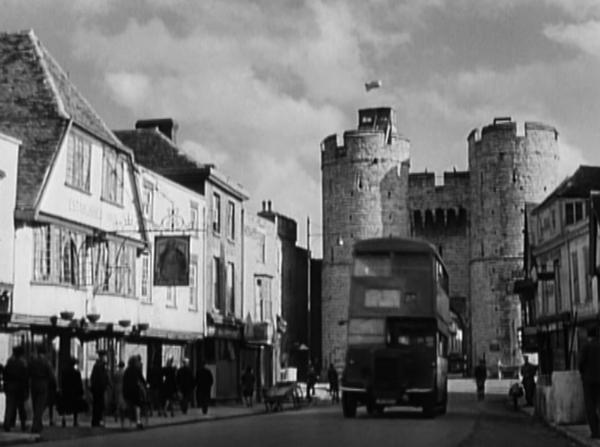
Chillingbourne does not exist, but it is made from real Kent places. Fordwich, Selling, Wingham, Chilham and Canterbury appear, alongside the Cathedral. Powell grew up near Canterbury. The film was made during the war, after bombing had damaged parts of the city, and it pays close attention to the roads, railway stations and fields through which its characters travel.
The fictional name is part of the film’s oddness. Chillingbourne is not an attempt to hide where it is. It is a composite village, assembled from places the directors knew well. The story is free to invent a glue man and a magistrate with a grand theory of English history, but its landscape has to feel real.
A village near Canterbury could have been represented with a studio set and a few trees. The film would have been neater and much less interesting. Instead, the landscape keeps interrupting. There are long walks, a field of hay, small lanes, a railway line, a village hall and the sound of bells in the distance. The trip to Canterbury is the subject of the film, not the bit between its plot points.
The Cathedral is more than a landmark saved for the last reel. It is the reason the characters are there. The past hangs around them, sometimes a little heavily. A local magistrate lectures on Kent’s history while a war is underway. An American soldier is introduced to a county that believes it has been here for a very long time and has no plans to become modest about it.
Few British films are this interested in a county. Even fewer make the journey from a village near Canterbury to the Cathedral feel like an adventure.
Andrea Arnold’s Bird, released in 2024, takes a very different route through Kent. It is set in north Kent and filmed around Gravesend, Northfleet, Dartford, Leysdown and the Kingsferry Bridge. Its world is estates, footbridges, roads, waste ground and the less photogenic edges of towns. The countryside is close by, but so are the pylons and the traffic.
Arnold has no interest in showing off the county. That is partly what makes the setting work. The roads, homes and views across the estuary are not offered up as local colour. They are simply where the characters live.
The film does not speak for north Kent, and it would be unreasonable to ask it to. It gives the area a specificity that most films avoid. The action is not shifted to a made up town outside London. Kent is named. Its mixture of open land, dense housing and industrial infrastructure shapes the film’s mood.
This Kent barely features in the county’s best known screen image. That image has a castle, a cliff, a country house or a beach where someone in a historical drama can look troubled while walking into the wind. Bird has a rougher, denser setting. A child can cross from an estate to scrubland in a few minutes.
It is not only a question of class or scenery. The Kent in Bird has an internal geography. The characters move through familiar routes and half-finished spaces. The place has its own scale. It is neither London nor an anonymous provincial town, even where the film leaves the exact location unsaid.
Empire of Light sits between those two approaches. Sam Mendes used Margate and nearby places extensively: Dreamland, Arlington House, the station, Broadstairs, Manston and the East Kent Railway all made it into the film. The art-deco frontage at Dreamland became its central cinema setting.
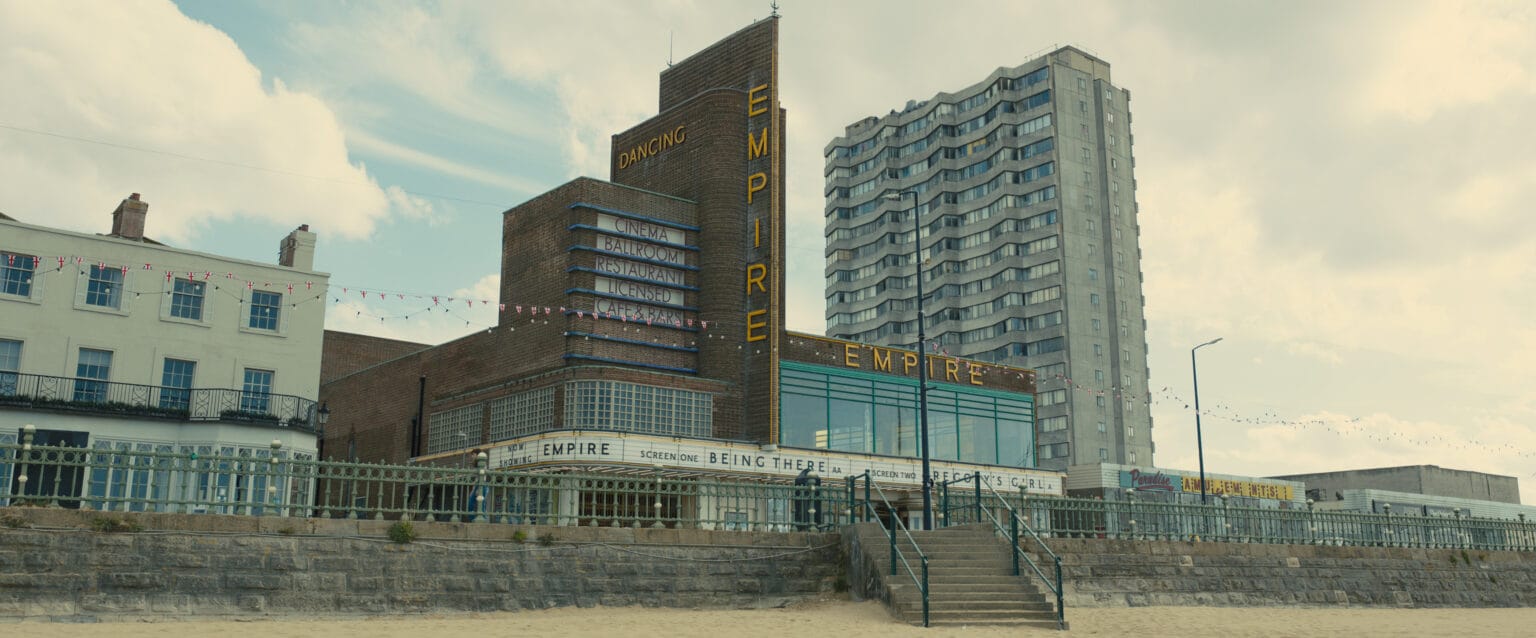
Margate is visible throughout, but it is not quite Margate. The film takes place in an unnamed south coast town in the early 1980s. Anyone who knows the area can see where it was made. Everyone else sees a promenade, an amusement park, a long beach and faded grandeur.
Calling it Margate would have changed the film. The name brings its own history, with the town’s shifting fortunes, the Turner Contemporary, the argument about art and regeneration, the uneasy relationship between a seaside resort and its visitors. An unnamed south-coast town can take the architecture and the sea while making up the rest.
This is the advantage and cost of Kent’s screen versatility. A place gains a second life, but gives up control of the story. Margate can be borrowed for a drama about cinema and loneliness. Chatham can become the past. Brands Hatch can become Italy. The audience gets the atmosphere, but Kent remains in the background.
The wider filmography shows the range. Mr Turner used the Medway and Stangate Creek, while the Dockyard stood in for a vessel on the Thames. Jason Statham’s The Beekeeper used Castle Farm and the Kingsferry Bridge. Wes Anderson made his Roald Dahl short films largely at Maidstone Studios.
There is a satisfying absurdity to the list. The same county has served Brad Pitt in a racing film, Marvel superheroes, Dickens adaptations, Wes Anderson’s formal little worlds and Andrea Arnold’s north Kent estates. A place that can supply all of those things is hard to reduce to a single film image.
Most counties would be grateful for one famous location. Kent has too many competing versions of itself. Chatham’s industrial history is as useful to a filmmaker as a castle in Dover or a beach in Thanet. Marshes can look timeless until a pylon enters the frame. A camera pointed twenty degrees in another direction can turn a well-known place into a foreign city.
Kent will keep making a good stand in. It can become 19th-century London because it has not been too tidied up. Dover can become Sokovia because a fortress with tunnels looks more convincing than a studio set. Brands Hatch can become Monza because an audience only needs to believe the image for a few seconds.
None of this diminishes the pleasure of spotting somewhere familiar in a blockbuster. A recognisable road, building or stretch of coast can be more memorable than the scene it appears in.
But A Canterbury Tale and Bird offer a rarer deal. They do not ask Kent to be interchangeable. One finds a county full of wartime pilgrims, old stories and stubborn local history. The other finds estates, scrubland and the difficult edges of north Kent. Both would lose something important if they were moved elsewhere.
At the Italian Grand Prix in F1, Brad Pitt is crashing at Brands Hatch. Kent has become very good at that sort of deception. But it's more interesting screen life exists when the name stays in the script.