Less scrutiny, but more prayers and singing
Kent’s council chamber gets more performative as Gormley sale raises fresh questions and Kent MPs choose sides over Starmer
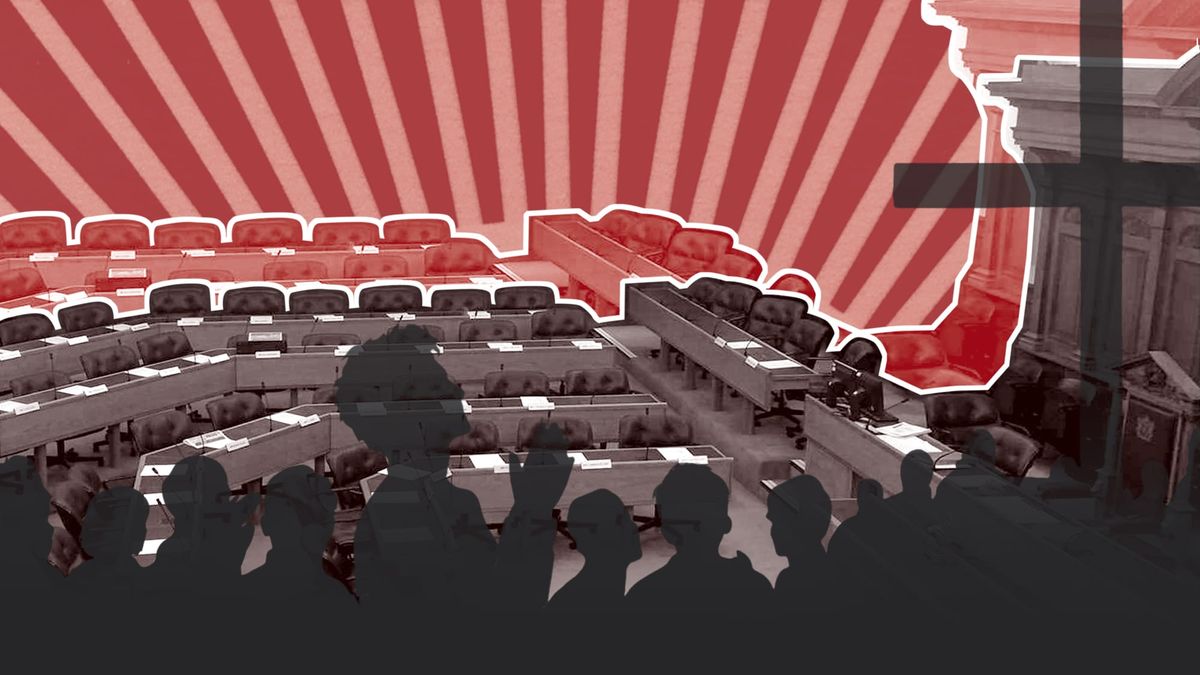
Kent County Council could introduce prayers and the national anthem at full council meetings while reducing the time opposition leaders have to respond to the administration. We also look at fresh questions over KCC’s sale of Antony Gormley’s Two Stones and how the Starmer crisis is dividing Kent’s Labour MPs.
Less scrutiny, but more prayers and singing at County Hall
Kent County Council has many problems. Roads that do not work properly, B buildings needing hundreds of millions of pounds in maintenance, a special educational needs system under pressure, and rising demand in adult social care. Meanwhile, local government reorganisation is looming over everything.
Inevitably, priorities have to be made somewhere.
So, of course, Kent's Reform administration has turned its attention to the urgent business of getting councillors to say the Lord’s Prayer and sing the national anthem.
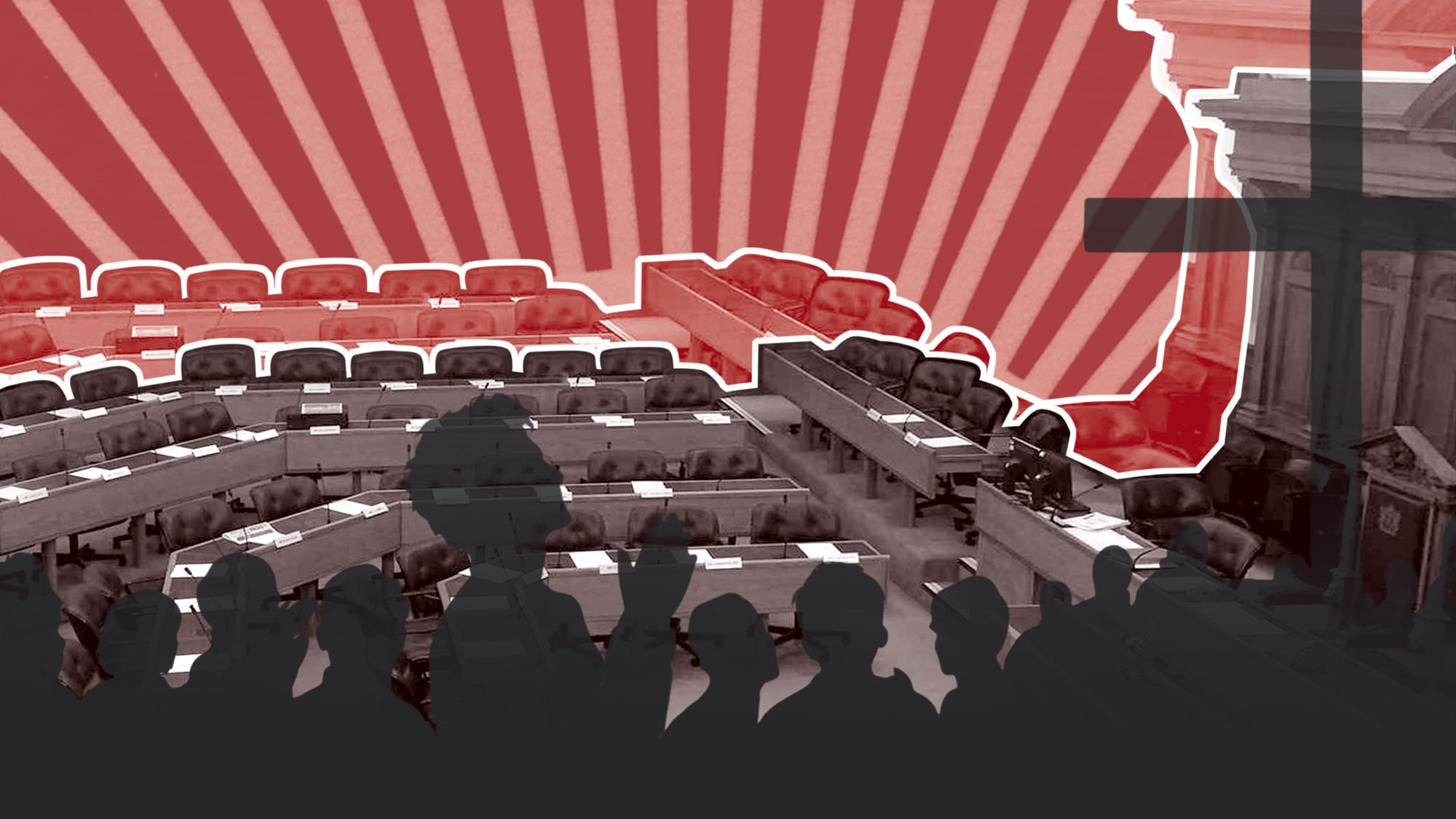
At a meeting of Kent County Council’s Selection and Member Services Committee last week, councillors backed plans that could see full council meetings begin with the Lord’s Prayer and end with God Save the King. The proposals will now go to full council later this month, where all councillors will decide whether this is what Kent County Council needs to spend its time on.
The proposals formed part of a wider report on constitutional changes. Some of that report was ordinary council machinery. Budget meetings, committee membership, attendance records, scrutiny call-ins, public participation, and the rules around how meetings are run. Procedural plumbing, mostly, until something starts leaking.
Then came the bit about prayers.
The report noted that councils are legally allowed to include prayers or other religious observances in meetings. It also made clear that this is optional. Nobody can be forced to take part, and councillors, officers and members of the public all have a right not to have their religious or philosophical beliefs exposed by the way they behave in the chamber.
The Monitoring Officer warned that if prayers were introduced, they would need to be optional and handled carefully. One possible option was for those who wanted to pray to do so outside the formal meeting. Another was for prayers to take place off-camera, so that nobody watching the webcast could identify who was joining in, who was sitting silently, or who had decided to leave the room.
The same applied to the national anthem. The report stated that views on the monarchy and the singing of the anthem may be legitimately held, that nobody could be compelled to participate, and that non-participation should not be recorded. If councillors wanted to sing the national anthem after every full council meeting, the report said it should happen after the formal meeting had closed, off camera, with time for those who did not want to take part to leave.
That was the advice.
Reform councillors then pushed for both to be broadcast.
The committee had already backed a proposal to cut the time available for opposition group leaders to respond to the leader’s report by one minute each. The stated reason was to save time in long council meetings. The saving would amount to a few minutes across an all-day meeting.
Having found a way to reduce the time given to opposition scrutiny, the committee then found time for prayers and patriotic singing.
Less time for elected opposition leaders to respond to the leader of the council. More time for public performance of faith and loyalty to the crown.
Andrew Kennedy, the Conservative councillor for Malling Rural East, opposed the proposal for prayers. He told the committee that his husband is an ordained vicar, but that he himself is agnostic. “I was elected as an agnostic, not as a representative of any faith community,” he said. “I wasn’t elected as a religious representative, and the decisions I make are not guided by God or any other religious leader. They are guided by my principles as an elected politician and the people I represent.”
After the meeting, Kennedy put it more bluntly: “I was not sent here to practice my religion or my patriotism.”
Councillors are not sent to County Hall to demonstrate how Christian, patriotic, monarchist, secular, devout, republican, loyal, prayerful or tuneful they are. They are sent there to run services, scrutinise decisions, approve budgets, and ask why the council is not doing a better job of the things it is supposed to do.
Green group leader Mark Hood made a similar point. Citing the 2021 census, he noted that fewer than half of Kent residents identify as Christian, while a large proportion say they have no religion. “I firmly believe that religion is a personal matter and that we should operate in this council in a wholly secular manner, to respect the followers of all religions and none,” he said.
He also asked the obvious practical question. If the council is going to start with the Lord’s Prayer, which version will it use? The traditional version? The modern Anglican version? The version familiar to Catholics? One prayer can start looking less like a harmless tradition and more like a surprisingly efficient way of making even Christians argue with one another.
Antony Hook, Liberal Democrat group leader, argued that Kent County Council is not a religious body. “We’re a statutory body, we’re a non-religious body, we’re a part of the state, and we’re exercising functions that are not religious functions,” he said. “Our functions are to provide a really good social care service, to fix the roads, to provide SEND provision. Those are not religious functions.”
He added that it was inappropriate for the council, as a workplace, to adopt a religious practice that implied “one faith will have some special status over the staff and members of different religions or of no religion at all.”
The counterargument from Reform and its allies was not especially subtle. Richard Palmer, who chairs the county council, argued that “we are a Christian nation.” Maxine Fothergill, of Restore Britain, said she did “not see a problem” with the proposal and that members who disagreed would be welcome to sit out that part and come in once the clergy had finished.
That is precisely the issue. The whole point of council meetings is that elected members, officers, the press and the public can be present for the democratic business of the authority without having to signal their private beliefs. Telling people they can always leave the room is not quite the inclusive gesture its supporters appear to think it is.
Cllr Chris Hespe later defended the move on X, writing that it was “simply bringing back what we used to have at Kent County Council” and “reminding us all that this is a Christian country, and we should all unite behind the nation’s anthem and flags.”
There it is. This is not just about the smooth running of Kent County Council. It is about symbols. Prayers, anthems, flags, monarchy, Christianity. Unity, as defined by the people deciding what everyone else is being asked to unite behind.
The national anthem proposal followed the same pattern. Hood said full council was not “the Last Night of the Proms” and told those who wanted to sing songs to do so elsewhere. “If this is going to eat into the time allocated to the democratic processes being undertaken in this room, then it’s absolutely unacceptable,” he said.
Kennedy described the idea as “jingoistic national anthem singing,” while Liberal Democrat councillor Tim Prater cut straight to the point, declaring that “loyalty to this country does not involve singing a song.”
Reform councillor Garry Sturley saw it differently, describing the national anthem as “just standard patriotic tradition.” Palmer added that there was “nothing wrong with being loyal to the crown” and “nothing wrong with being loyal to this country.”
Nobody has seriously argued that there is. The question is whether Kent County Council meetings need to become a venue for councillors to publicly perform that loyalty at the end of every meeting.
Rob Yates, the Green councillor for Cliftonville who dispatched Reform in a by-election last month, summed up the opposition case. “This chamber is not a place of worship. We are elected to serve all our residents in Kent regardless of their belief. We are not elected in order to pray to God in this chamber or to sing to the King, although many of us are happy to do that.”
He added that the council should keep its focus on serving residents rather than “serving the political aspirations of either Nigel Farage or Rupert Lowe.”
The row has now moved beyond County Hall. The National Secular Society has written to councillors urging them to reject the prayers proposal, warning that it would “throw fuel on the fire of community tensions” and cause “unnecessary division.” Its head of campaigns, Megan Manson, said councillors “are not elected to represent gods, but the diverse people of Kent.”
There is a more generous interpretation of all this. Some councils have historically included prayers. Parliament still does. Civic life is full of old rituals, some more useful than others. There are councillors who will sincerely see the Lord’s Prayer and the national anthem as expressions of continuity, service and respect.
But Kent County Council is not short of things to do. It is not a parish council with nothing on the agenda but the minutes, a planning application and a complaint about dog mess. It is responsible for services used by more than 1.6 million people. It is facing enormous financial pressure. It has serious questions to answer over the condition of its roads and estate. It is heading into local government reorganisation, a process that could reshape councils across the county.
Against that backdrop, choosing to spend political capital on prayers, anthems, and flags is not a harmless tradition. It is a statement of priorities.
The same committee was asked to consider other changes that could have opened up or strengthened local democracy. A review of scrutiny call-in arrangements. Options for public participation. A proposal that opposition leaders be given a summary of the leader’s report in advance so they could respond properly. These are the kinds of changes that might make County Hall more accountable, more useful, and less opaque to the people it serves.
The committee rejected the idea of the leader sharing her report summary in advance. It backed reducing opposition response times. It backed sending the prayer and anthem proposals to full council.
Kent County Council may soon have less time for opposition leaders to scrutinise the administration, but more time for councillors to pray, sing, and stand behind the right symbols.
The proposals now go to full council on 21 May. By then, councillors may have to decide not only what kind of meetings they want to hold, but what kind of council they want Kent County Council to be.
How did KCC sell a major artwork with no formal decision?
When we last wrote about the sale of Antony Gormley’s Two Stones from outside Maidstone library, Kent County Council had confirmed it had sold the sculpture back to the artist, but was refusing to explain the basics of the deal.
 Ed Jennings
Now we know a little more. It makes the whole thing look worse.
In response to a Freedom of Information request from the Kent Current, KCC says there was no formal decision to sell Two Stones. It says authorisation for the sale was not given by an officer. It says no formal decision record exists. And it says there was no internal briefing note or report outlining the rationale for the sale. The council does confirm that the sale was completed on 29 March.
That is an extraordinary set of answers for the sale of a significant public asset.
This was not an old desk being cleared out of County Hall. Two Stones was a major public artwork by one of Britain’s best-known sculptors, and it sat outside the Kent History and Library Centre in Maidstone for years.
When KCC first confirmed the sale to us in April, it said “the decision to sell Antony Gormley’s Two Stones back to the artist was taken carefully” as part of its response to financial pressures. But if the decision was taken carefully, where is the record of that care? If no formal decision was taken, no officer authorised it, and no internal report set out the rationale, what exactly was the process?
KCC is still refusing to say what price it achieved. Its FOI response says the sale price is covered by a confidential sale agreement, while valuations for the work are being withheld as commercially sensitive. It also says correspondence relating to the sale cannot be disclosed for the same reasons.
So the position now appears to be that a major public artwork was sold in a private deal, but there was no formal decision, no officer authorisation, no formal record and no internal report setting out the rationale; and the public is not allowed to know what the council got for it.
The Kent Current has submitted an internal review challenging KCC’s refusal to disclose the sale price and valuation information, arguing there is a strong public interest in revealing what return the council achieved from the disposal of a significant public asset.
Councils do sometimes sell assets. Councils under financial pressure make ugly choices. But if KCC’s answer is to quietly turn public art into cash, the least it should have to do is show its working.
Keeping track of Kent properly takes time, travel and a fair amount of patience. Kent Current only exists because some readers choose to support that work. An annual subscription costs £1.15 a week and helps keep it going.
Starmer crisis splits Kent’s Labour MPs
For Kent’s Labour MPs, the Starmer project is not an abstract Westminster drama. It is the reason many of them are in Parliament at all.
In 2024, Labour won across parts of Kent that had either been Conservative for years or were never obvious red territory.
Less than two years later, the Prime Minister who helped carry much of that map is fighting to keep hold of his own party.
Kent’s Labour MPs have not all landed in the same place.
The clearest local break came from Naushabah Khan, the MP for Gillingham and Rainham, who resigned as a Parliamentary Private Secretary to the Cabinet Office and called for new leadership.
“The message from last week’s elections was clear: the Prime Minister has lost the confidence of the public,” Khan said. “We need a clear change of direction now and no game playing.”
Kevin McKenna, the MP for Sittingbourne and Sheppey, has also called for Starmer to go. In a statement, he said he had hoped not to speak publicly while the Prime Minister considered his position, but that Jess Phillips’ resignation letter had changed that.
McKenna pointed in particular to online child protection legislation, saying that he was “not just disappointed by this, I am truly angry.”
His conclusion was blunt. “I believe it is now time for a new Prime Minister to lead our party and to deliver on the commitments we made to this country.”
Tony Vaughan, the MP for Folkestone and Hythe, joined them. His argument is less about immediate outrage and more about electoral survival.
“Labour needs a second term to renew this country after years of Tory failure,” he said. “On the current trajectory, we won’t get there because we will lose, and Farage will win. That should be nobody’s legacy.”
Vaughan said voters remained frustrated by the pace of change and angry about mistakes, including winter fuel, benefit cuts, and the Mandelson row. He said Labour was being “hamstrung” by a leader who had become “the personification of earlier — serious — mistakes.”
Others are sticking with Starmer.
Mike Tapp, the MP for Dover and Deal, warned against another leadership change. “The country needs stability, not another revolving door of leaders,” he said. “Keir Starmer was elected to deliver change, and that work must continue.”
Lauren Sullivan, the MP for Gravesham, also backed Starmer. She acknowledged there was “appetite and impatience” in the country for change to happen more quickly, but said Starmer had recognised that pace needed to quicken and “has my support to do so and remain as Prime Minister.”
Tristan Osborne, the MP for Chatham and Aylesford, made a similar argument. Starmer, he said, had been elected on a mandate for change in 2024, including winning “the largest number of Parliamentary seats in Kent in my lifetime.”
Osborne said Labour’s focus should remain on improving the lives of constituents rather than turning inwards. “I do not believe now is the time to become introspective,” he said.
That leaves the remaining Kent Labour MPs in a more awkward position, either quieter, less publicly visible, or not yet as firmly defined as their colleagues. In a normal week, that might not mean very much. In a leadership crisis, silence becomes its own small political weather system.
The split is now visible. Kent’s Labour intake arrived at Westminster as proof that Starmer could win in places Labour had long struggled to reach. Now, some of those same MPs are deciding he is the thing standing in the way.
Footnotes
Follow us on social media! We’re on Facebook, BlueSky, and Instagram for now.