“I like to hide from public view”
What we asked A W Earl, author and folklorist

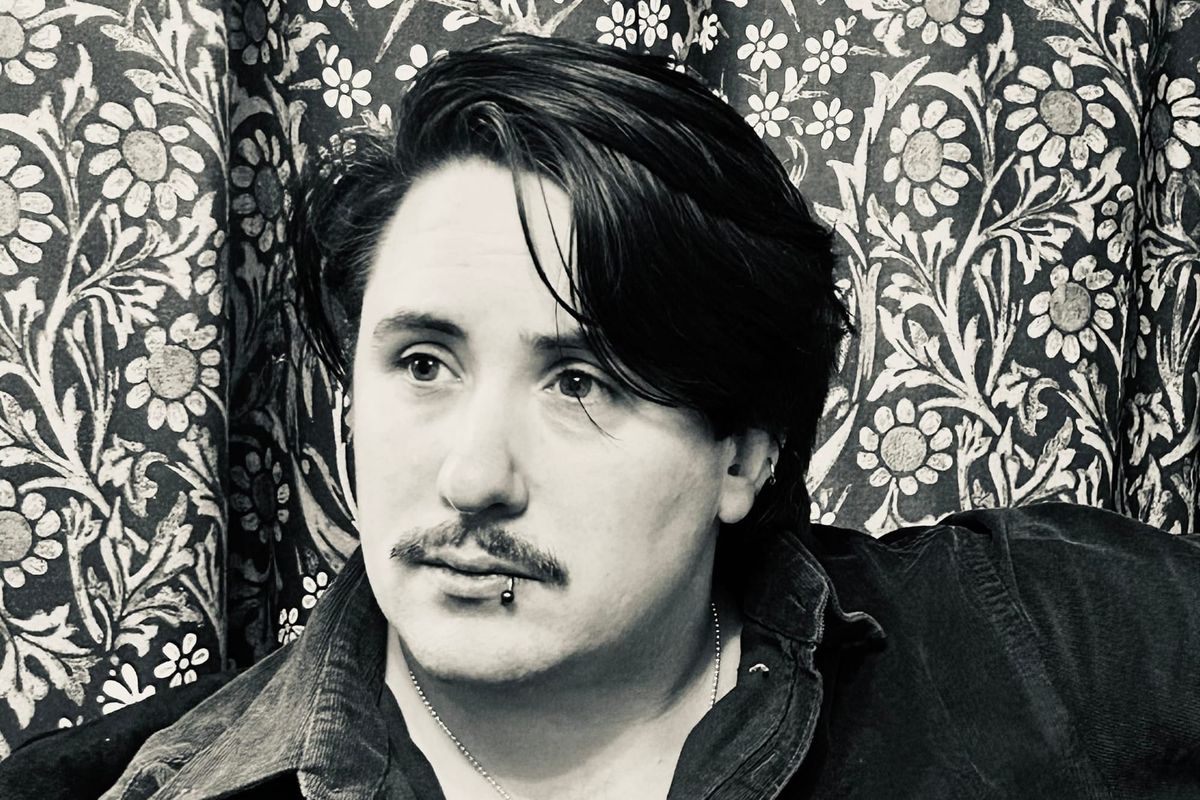
Steven first met A W Earl at the Medway River Lit festival, where he purchased and later enjoyed their debut novel, Times Fool. Having recently interviewed their father, Rob Earl, it was a perfect opportunity to follow up and talk about being a folklorist, publishing with Unbound, and gender fluidity...
What is your official occupation?
I'm a writer.
What does the role entail?
It's always the difficult question. Writing obviously is what I want to be doing with my time. It's what I spend a lot of my time doing, editing and creating my own work. Obviously, like most people in the industry, I wear a lot of hats. I write for magazines, I write reviews. I sometimes edit other people's work. I've done a bit of library cataloguing. Basically, gig economy. It is what it is.
Do you have any current book plans?
I'm working quite heavily in poetry at the minute. I've had a lot of poetry published. I'm looking at putting together my first collection. I'm working on novels, and they're out on submission. I've had some interest but nothing that's come to anything yet. There's stuff in the pipeline.
Do you have any other additional roles, paid or unpaid?
The area I live in is currently having its first pride festival, and I'm running a poetry competition for that. I volunteer at a local museum as well. The museum is Trimontium Roman Fort Museum, which is niche in its way, but it's great. It's one of the largest Roman forts in Scotland, and not a lot of people outside of the area know about it, but it was strategically important in its day.
You are also a folklorist?
Yes. Oh God, I didn't mention that. That was my academic study. It's an ongoing thing. I’m a storyteller as well, as one of the other many hats I wear. That involves a level of interest into folktales. Academically, I was interested in the transmission and fluidity of folk narrative, and I specialise particularly in Scots Border ballads. I'm in the perfect area for that.
We look at them as these archetypal fixed stories, but they actually exist in many versions
‘Fluidity within folklore.’ Can you give us an example of mean by that?
I don't know how academic to get really with this.
The idea is that folklore is either a fully oral tradition, or it sits on the edge of literacy. People in society can read and write, but not everyone does. Stories happen in that space. They flow out of literature and into folklore and out of folklore and back into literature, and they change as they do so based upon the sort of material conditions of the time, and the prejudices of the people and the desires of the people who are telling the stories.
Literary works have their own characteristics that you can recognise, and folkloric works have others. Three-dimensional characters are much more common in literary works. Things tend to be big, bright colours in folklore. I'm interested in how things move between Chivalric romance and Border ballad. Border ballads were quite a late orality although sometimes some of the roots of the stories are much older. They're early modern rather than pre-medieval.
We look at them as these archetypal fixed stories, but they actually exist in many versions. I love to look at and find different versions of the same ballad that have been recorded across time and look at exactly how little nuances of sense and meaning shift between them.
Was there a particular piece of folklore that got you into this?
My parents were involved in folk revival stuff. I grew up with a lot of folk music playing when I was a kid. I think for me it was always Tam Lin. It's always going to be Tam Lin. It captures the young imagination very thoroughly, and the Fairport version of that is part of the soundtrack of my life. Getting into what created that has been fascinating for me. But from there it's just gone everywhere really.
What would you say are defining differences in folklore either side of the Scottish Border?
The Borders were a lawless zone from the wars of independence through to the union of the crowns. The reiving culture developed in this area was a high honour culture, but was incredibly violent. There were a lot of betrayal and revenge and longstanding family feuds. The Borders have been ignored by both governments. I'm talking about parts of Cumbria, most of Northumberland, what is now East Lothian, what is now Scottish Borders, and a bit of what is now Dumfries and Galloway. They were impoverished. A culture came up around cattle stealing. Cattle were wealth in that period. If you didn't have any major oversight, there were legal forms of murder you could commit. The ballads weave in and out of this strange legal and social system that capture that uncertainty and the wildness of the landscape. It's unusual.
From the 17th century onwards, obviously things became much more a contiguous part of their individual countries. For a lot of that mindset, a place a bit resistant to change, a place that keeps to itself, remains very strongly in the area.
Your novel, Time's Fool. What can you tell us about that?
That came out in 2018. It's quite a while ago. It was published by Unbound, which is a crowdfunding publisher, small independent press, which has since unfortunately gone bust. So, it's out of print. If people want copies, I have some. They can contact me on social media, I can post within the UK.
That was a vampire novel. The other great love of my life is the Victorian Gothic. It was written in response to a lot of the stories that I grew up reading, obviously Dracula, Carmilla. In the 90s, you could often get published collections of lesser-known horror fiction. When I was a teenager, I used to devour these, and there was often a vampire story in there, and a lot of that influenced me as well.
How did you come onto Unbound's radar?
Social media. It was in the old days of Twitter. Someone reposted a call for submissions, and I thought 'I could do that.'
How was your relationship with Unbound?
It was complicated. I had suspicions at points that something a bit dodgy might have been going on. Some people have been really badly let down by them as a publisher. I wasn't personally, but I was wary towards the end. I distanced myself a bit from the whole thing because I felt stuff was maybe not all above board.
I am not great at continuous self-promotion
Having had a successful crowdfunder, was there anything in that experience where you would consider self-publishing your next novel?
No. One thing I learned about myself is that I am not great at continuous self-promotion. I did not enjoy the crowdfunding experience. I'm quite shy, and I can do a big talk once in a while, and then I like to hide from public view. Whereas for crowdfunding you've got to be on the ball for the whole campaign, just driving it. A lot of writers are quite shy people, and that is quite a hard thing for me.
Want the full interview? You'll need to become one of our supporters.
Our only income is from readers who choose to back our work, so if you want access to the most interesting stories from across the county, please consider joining them. An annual subscription costs £1.15 a week and helps make our work possible.
Being a fan of gothic and vampiric lore, what would you say is something that is most misunderstood or misrepresented in the public understanding?
I think my big complaint is that you were only allowed to take vampires seriously if they are Count Orlok, horrific monsters. The vampire myth has long been deeply tied up with questions of desire. When we talk about desire, the Anglophone world gets scared and silly. They like to make it all into a big joke, and I just wonder why. I've never understood that cringe response to talking about desire, about longing, about sexuality. There is strangeness in that field. I like to write into that space and to focus on that space, and I do it, and there's always going to be an element of camp and performativeness to that, but I like to do it with seriousness. Often people are uncomfortable around that. If it's going to be sexy, you've got to have a laugh at the end. I don't see why.