“It's about filling people with ideas and hope”
What we asked Mark Thomas, performer and writer.
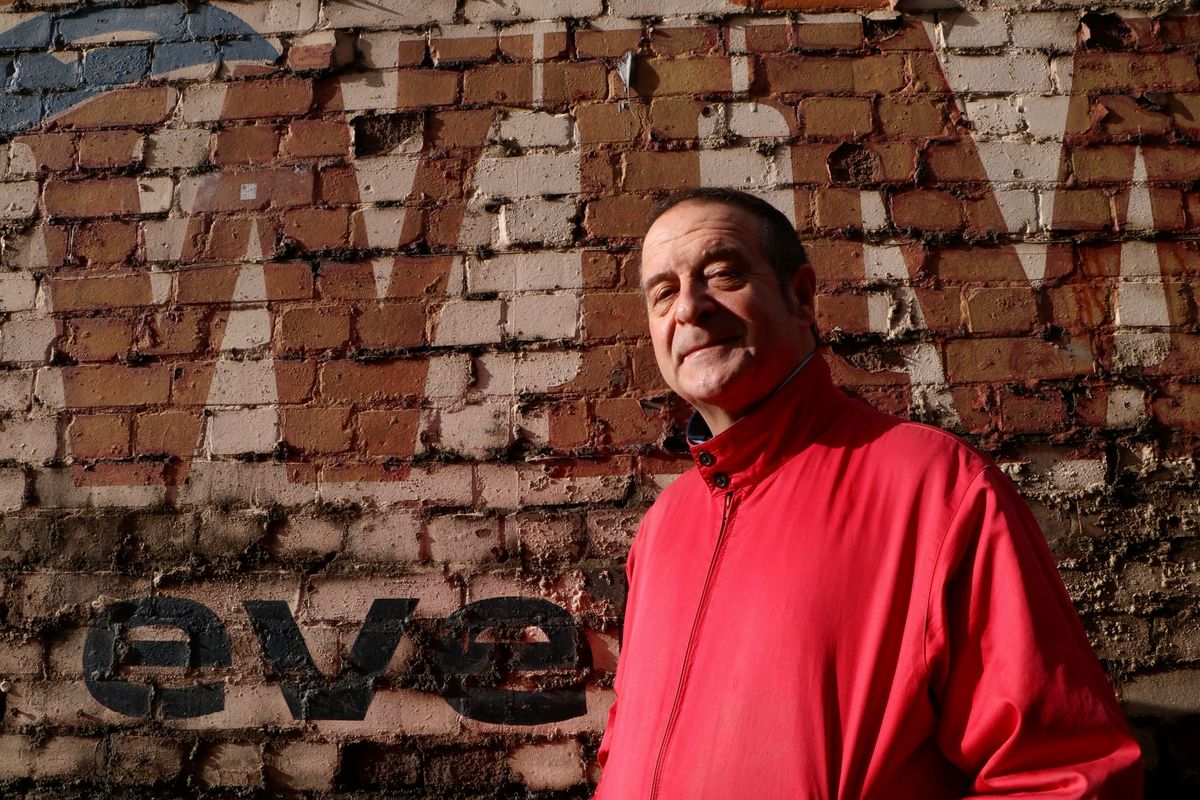
When we look for people to interview here at Kent Current Towers, we ask what their connection to Kent is. Sometimes they were born here, they lived here, or they worked here. Sometimes the connection is strong, sometimes it is tenuous. Sometimes they receive an honorary doctorate from the University of Kent. Mark Thomas has been performing comedy for 40 years, and Steven has happily been in the front row at many of those shows. Somehow, he managed to contain his squee when he met Mark via Zoom, and they talked about warming up in Faversham, performing opera for his father, and redefining Farage.
Are you known by any other names?
Yeah, but I don't think we can print them.
What is your official occupation?
Performer and writer. I'd love it if you could get it on the passport, because they don't give you a chance to put your occupation on passports now. But I really wish they would, and I'd really like to put in 'Bohemian.'
Do you have any additional roles, paid or unpaid?
I’m involved in all sorts. I'm a patron for IMET2000, which is a medical charity. There's two separate parts, one which trains people, Palestinian doctors, nurses, psychiatrists, clinicians, that we get the best possible training for the medical staff there. That's called IMF2000. There's another part of that which trains people in places like Uganda, where there is health poverty and inequality. I'm involved in them. They're great fun. A host of other organisations, which are pledged to the destruction of capitalism. I've a blood oath which I can't share too much about.
You're also a pastor?
Yeah, I became a pastor. I could do births, deaths and marriages, which is quite interesting. I've actually married someone. I like the role and the pastoral care that comes with a celebrant. I really like that. I like the fact that it celebrates other people while still remaining at the centre stage, which fulfils all the bits that I need. I think if ever I wanted to do another job, that would be it.
How did you end up with an honorary doctorate?
Over the years, I've worked on all sorts of campaigns. That just strikes you as wrong, and you just end up by accident and chance, working in campaigns that happen to you, and you get drawn into it. And Olly Double, who I've known for years, is one of the greatest resources in comedy ever. He's also a friend who I love very dearly, and I should say that. I would describe him in these words, even if he wasn't a friend, because what he's done is approach comedy and the study of comedy as a proper art form and an intellectual and academic endeavour which hitherto hadn't been done properly, and so he was really, I mean his knowledge of popular culture and comedy is endless and he runs the Stand-Up Comedy Archive, which is housed at the University of Kent, and I donate to. Loads of my stuff is in there. My notebooks, props, all sorts of stuff, and I'm delighted. I'm very proud of that. Because of all the work that I've done throughout the years, I was given an honorary doctorate at Kent uni.
Do you ever use Dr Mark Thomas?
I haven't, but now you mention it, I feel I shall today.
You either commit yourself to trying to make the world a bit better or just allow it to happen
Let's get the important bit out of the way. You're about to go on tour. What is the new show?
The show is called 40 In Stand-Up Years, and it is about me. Navigating, getting older with the ever-changing world, which seems to be in perpetual decline.
I think one of the big things that has changed in my life is that I was born in ‘63. I was born with a generation that grew up thinking that things would gradually get better. That's what happens, things just gradually get better for all of us. That has gone. That notion has been destroyed. This idea that things will gradually get better doesn't explain history, and it doesn't explain where we are now.
Rosa Luxemburg made that lovely quote saying, “We face socialism or barbarism.” We have a choice, and it is a choice. For me, you either commit yourself to trying to make the world a bit better or just allow it to happen.
Sorry, I didn’t mean to get that moral straight from the off.
As a writer and performer, you've done a wide variety of shows and books over the years. Is there a process to it? Do you think 'I'm going to campaign on X or protest about Y and I'll get a show out of it?' Or is it, 'I need a show for next year, this is winding me up, let's do something?'
There are many processes over the years. Some of them have literally been, 'I have to tell this story.' Some of them have been an accident. I was asked on Inheritance Tracks. You talk about music you inherited from your family and passed on to your family. I said that the music that I inherited and passed on is the same piece. It's Figaro's Aria from the Barber of Seville.
It was because my dad, who was a builder, used to play that on the scaffolding. Used to take tapes up. When you're 16, and you're working with your dad on the scaffolding and you're wearing an Anarchy and Freedom t-shirt, and your dad is playing Figaro's Barber of Seville and singing along with it, that's quite a deal. I used to be embarrassed by it. Now I'm proud of it.
My dad developed this illness called progressive supranuclear palsy and started to decline. It's a muscular degenerative illness, but there's a dementia element to it. What was fascinating was it was terrifying seeing him disappear before us. I found myself starting to play that music, starting to listen to opera, wanting to learn more about it, wanting to listen to more and understand, reaching out to him, really. I used to sing it to my children in the bath while I was washing their toes. I'd get their feet up, and I'd wash between their toes with all the soap going, (sings) Bravo Figaro, Bravo Figaro, Bravo Figaro, Bravo Figaro, Bravo Figaro, Bravo Figaro, bravissimo, doing all that.
Anyway, I told that story on Radio 4, and somebody in the Royal Opera House heard it and got in contact and said, “Would you come in for a meeting?” I went in for a meeting with Mike Figgis, the film director who was curating a festival. I looked him up before and thought, “Oh fuck, he's proper.” He said, “Are you interested in doing anything for the festival?” I said, “Yeah, but what I'll need is opera singers.”
We took the opera singers down to my dad's bungalow in Bournemouth, and we staged an opera in the living room. It was hilarious, it was amazing. My mum's dog insisted on sniffing all the fucking singers, and trying to get on the table to eat the buffet. We had to do a buffet for these singers. They're big people. They've got big appetites, so my mum is grabbing the dog. Robert from next door, he's been invited in, and his hearing aids are feeding back. My dad's sitting there, can't open his eyes. They do the opera, and then at the end of it, my dad was just absolutely back in the room. And we did an interview with him.
It's an interesting thing of how you create something and what it means to you and how you tell the story and what you have to tell because, we put it on at the Royal Opera House and my agent at the time came to see it and just went, “Wow, you really needed to tell that story. You needed to tell the story of your dad and what's happening.” I was trying to work out how it works, that whole process. I told the story because it naturally comes out. I then get asked to create a story. I specifically ask for the singers and take a sound recordist with me so they can record the opera and hopefully an interview with my dad. We were optimistic that something would happen. Then we go away and create the story. There's a whole mixture. How do you create it? Chance, necessity and planning. Those are the three ingredients. I think the thing about it is all of the shows have those elements. It's just they all have different levels of it.