Kent’s fire cuts defeated as politicians fight for credit
Station closures defeated, but the underlying problems remain, plus Kent's four new councils begin to take shape

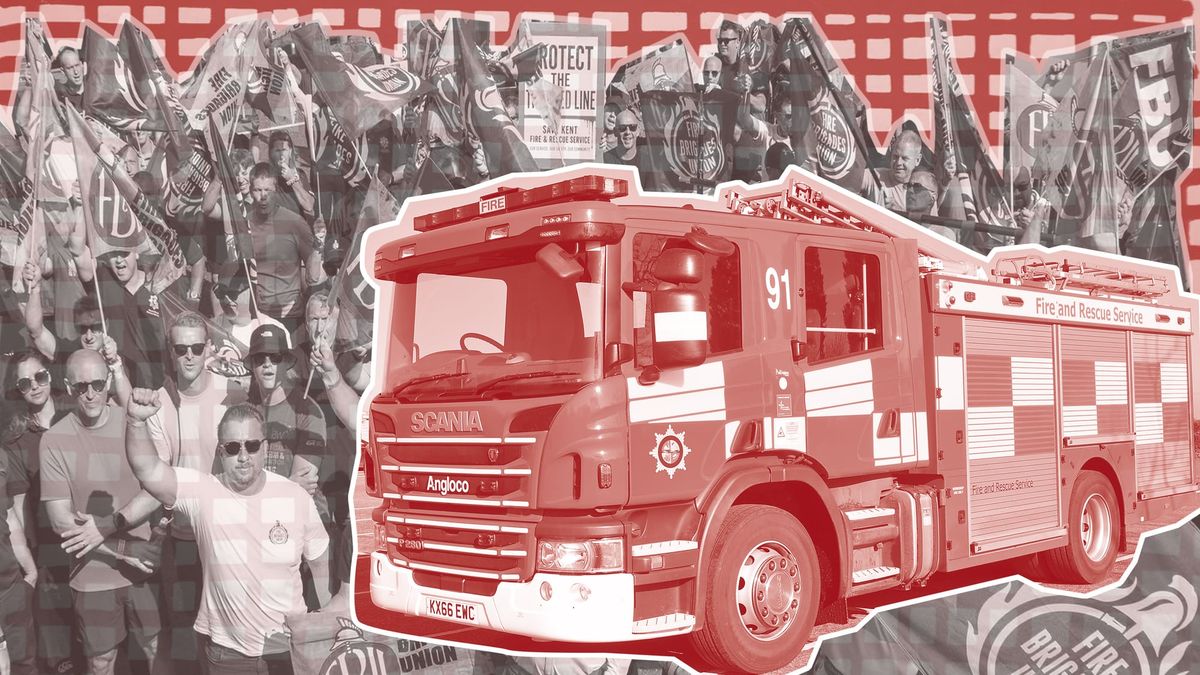
Plans to close four Kent fire stations and reduce cover elsewhere have been rejected after months of opposition and additional scrutiny, leaving politicians and campaigners competing to claim the victory. We look at what the vote protects, the operational and financial problems it leaves unresolved, and the first implementation details for Kent’s four future unitary councils.
Kent’s fire cuts defeated as politicians fight for credit
Plans to close four Kent fire stations and reduce cover elsewhere have been defeated, prompting the traditional rush by politicians to explain why it was all down to them.
The Kent and Medway Fire and Rescue Authority voted on Thursday against putting the revised package out to public consultation in a 17-2 vote.
On-call stations at Chilham, Wye, Cliffe and Westerham will remain open. Elsewhere, attached on-call provision will stay at Deal, Herne Bay, Faversham and Tunbridge Wells, while Dartford and Thames-Side will retain two fire engines overnight.
The decision followed months of opposition, two demonstrations outside County Hall and six weeks of additional scrutiny by a cross-party working group.
It took rather less than six weeks for the victory claims to arrive.
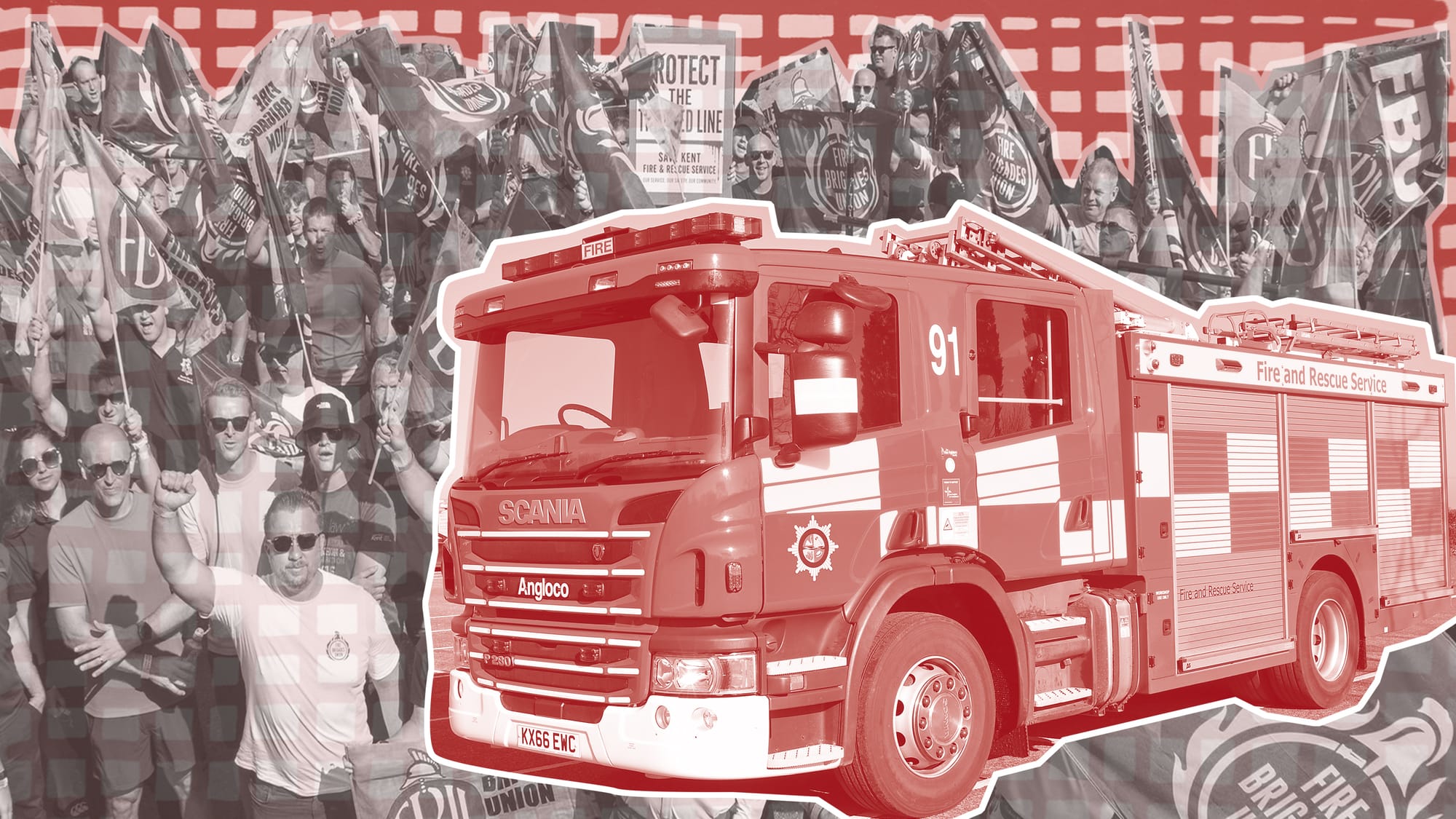
The FBU called the result a “stunning victory” for Kent firefighters and local communities. Its general secretary Steve Wright said rallies organised by the union had forced the authority to change course.
“Without our members forthright stand and organising impressive rallies over the last few months, we would not have forced this change,” he said.
Firefighters demonstrated in Maidstone again on Tuesday, two days before the vote. An earlier rally preceded the June authority meeting at which members halted the consultation and established the working group.
That intervention delayed the plans rather than defeating them. Members gave themselves six weeks to examine the evidence and find out whether there was a less contentious alternative.
The delay produced concessions, but not a replacement package.
Kent Fire and Rescue Service argued that its resources no longer matched when they were most likely to be needed. On-call stations depend on firefighters who live or work close enough to respond when alerted, but KFRS said those engines had become increasingly unreliable during normal working hours.
Its proposed answer was to move resources from quieter periods and lower-demand stations into stronger daytime cover.
Three additional wholetime engines would have operated between 8am and 6.30pm at Strood, Ashford and Folkestone. KFRS predicted that first-engine response times in those areas would improve, in some cases by more than a minute.
To help fund the change, the second overnight engines at Dartford and Thames-Side would have been withdrawn. Both stations would have retained two engines during the day and one at night.
Four standalone on-call stations would have closed, while on-call sections would have been removed from four stations that also have a wholetime engine. Seven new wholetime firefighter posts would have been created.
KFRS said no wholetime posts would be lost and there would be no compulsory redundancies, although on-call roles would have ended at the affected stations.
The FBU said the original package would have removed 63 firefighter posts and six engines, as well as closing five stations.
By Thursday, those plans had already been softened. Grain was removed from the closure list after concerns about the isolation of the Hoo Peninsula, with officers proposing to collect another two years of data before reviewing its future in 2028.
The four other station buildings would also have been retained for a year after their crews were removed. Members could then review whether demand had changed before deciding what happened to them permanently.
In other words, the stations would have closed, but the authority would have kept the keys handy. That was not enough to persuade members to let the plans reach the public.
KFRS chief executive Ann Millington said the proposals were based on “comprehensive data and evidence” and intended to strengthen daytime cover while relieving financial pressure.
“We would never propose to close a fire station without valid reasons or thorough consideration,” she said.
“Today’s outcome is disappointing, as there isn’t an alternative proposal to address the need for more daytime cover.”
That is the awkward part of Thursday’s victory lap.
During its six-week review, the cross-party group considered different staffing arrangements, further investment in recruiting and retaining on-call firefighters, additional wholetime resources and an alternative submitted by the FBU.
The union proposed enhanced payments to guarantee the availability of four on-call engines when cover was weakest, initially through a 12-month pilot. Depending on the hours covered, KFRS calculated that the options would cost between £230,000 and £682,000 a year including employer costs.
Officers concluded that the proposal would not provide the same reliable improvement as the wider package. They said none of the alternatives considered offered a better combination of operational effectiveness, affordability and long-term sustainability.
14 chief fire officers and their analysis teams were also invited to identify another viable option within the same budget. According to the meeting papers, none did.
The rejected changes were expected to release about £900,000. Approximately £500,000 would have paid for the seven new wholetime posts, with the remainder available for other investment or future financial pressures.
KFRS must now find another answer to its daytime availability problem, alongside £2-3m of other savings it says are required during the current strategy period.
There was less enthusiasm for discussing that once the political celebrations began.
Faversham and Mid Kent MP Helen Whately called the result a Reform UK “U-turn”, saying the party had finally realised “their plan” was a bad one.
The proposals were developed by KFRS management rather than written at Reform headquarters. But Reform has controlled Kent County Council since May last year and its councillors form the largest group on the fire authority, giving Whately an obvious political target.
She credited her petition, the FBU campaign and the firefighters who opposed the plans.
Reform councillors saw things differently.
Spencer Dixon said his party had stood with residents and frontline firefighters. He claimed the Liberal Democrats were the only party to vote for the proposals and had been “massively outvoted.”
Fellow Reform councillor John Baker said he rejected the package because he could not support reductions in frontline cover.
The result was therefore not a Reform retreat in their telling, but Reform riding to the rescue.
Labour also claimed a role. Its KCC group leader Alister Brady said Labour members of the authority recognised the problems caused by changing demand, recruitment difficulties, engine availability and emerging risks such as wildfires.
But he said the package attempted too many significant changes at once and had not adequately addressed the effects on individual communities.
Dartford Labour MP Jim Dickson celebrated the retention of his town’s second overnight engine, crediting residents, firefighters and campaigners who signed petitions and contacted councillors.
By Thursday afternoon, the decision had apparently been delivered by union rallies, petitions, residents, firefighters, Labour MPs, Labour councillors and Reform councillors. Depending on whose account you prefer, Reform either stopped the cuts or belatedly abandoned them.
Behind the competing versions is a simpler result. Authority members overwhelmingly rejected an unpopular package before it reached public consultation.
They preserved four standalone stations, on-call provision at four others and two overnight engines. They also rejected the linked increase in daytime cover.
As a result, Kent’s existing fire cover remains intact, but so does the problem KFRS was trying to solve.
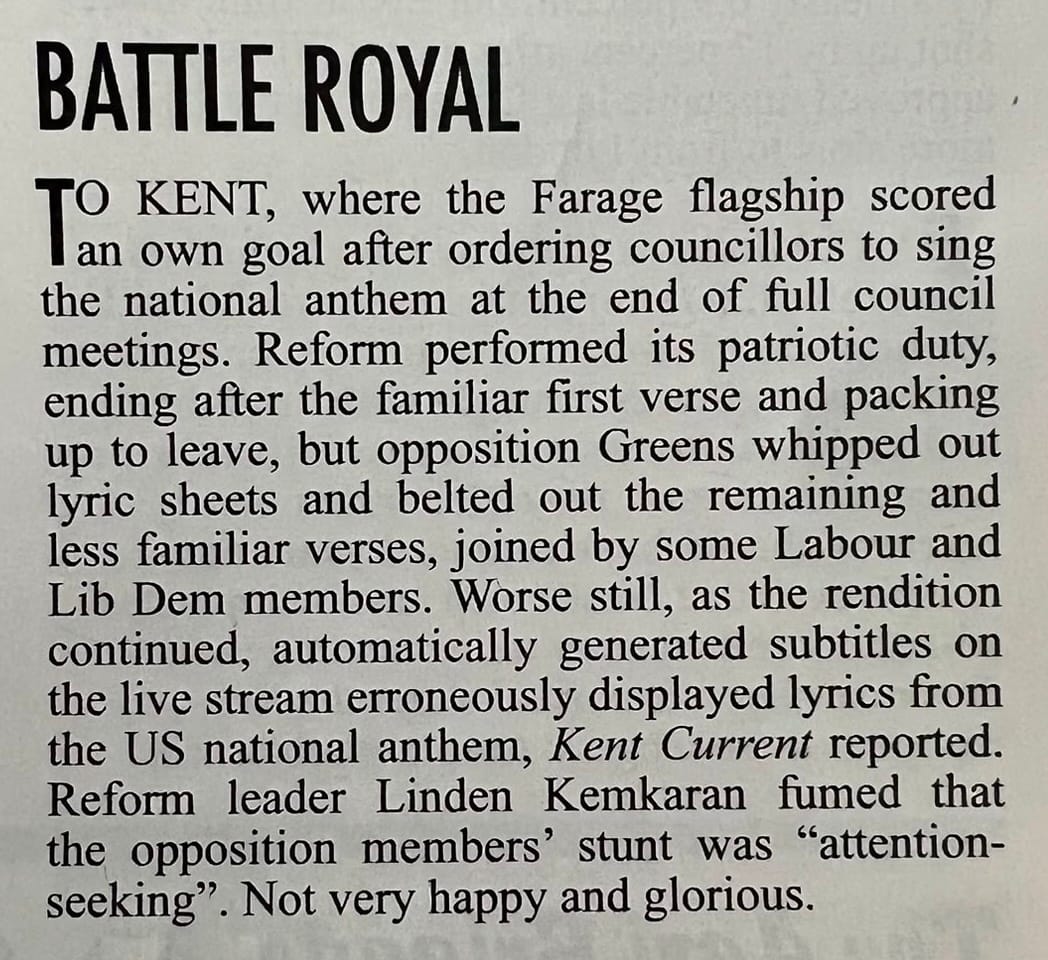
Our recent story about Kent County Council's national anthem saga has found its way into this week's Private Eye, appearing in the - offered without comment - Rotten Boroughs column. It's always nice to see Kent Current reporting reaching a wider audience, even if the route there involved councillors singing six verses of God Save the King while subtitles confidently switched to the Star-Spangled Banner.
Kent’s four new councils get their names
Kent’s four new councils have been formally given names that are unlikely to trouble future historians of municipal imagination.
North Kent Council, West Kent Council, Mid Kent Council and East Kent Council are the names ministers intend to put into the legislation establishing the new authorities.
The decision is contained in an implementation letter sent to the chief executives of Kent and Medway’s 14 councils following the government’s decision to reorganise local government across the county.
This story continues below. Register for a free Kent Current account to keep reading and receive our main editions straight to your inbox.