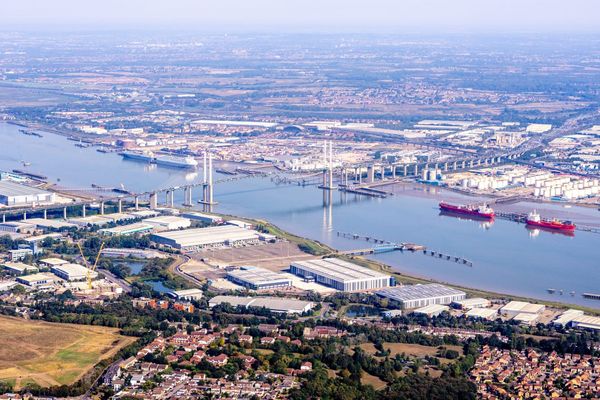
The Northfleet plan that promised almost everything
Plus Margate’s art boom, Dover’s unwanted political spotlight, a critical incident at East Kent hospitals and Costco coming to Aylesford

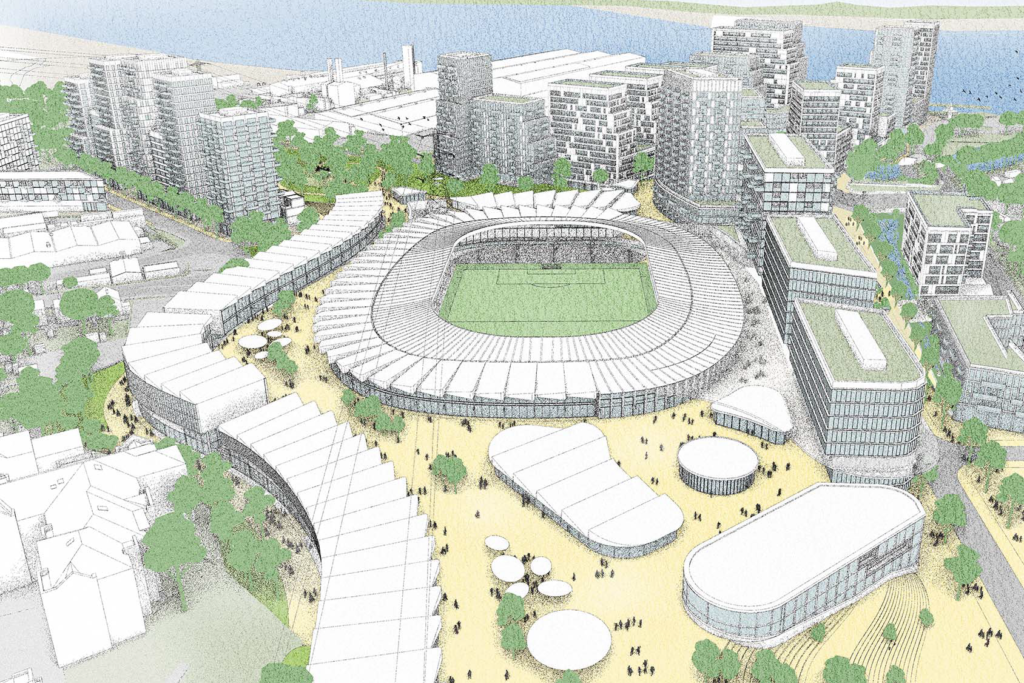
Northfleet was promised 3,500 homes, a football stadium, parks and thousands of jobs, but a public inquiry found remarkably little evidence that most of it would happen. Elsewhere, Margate considers the cost of its art boom, Dover tires of being used as political scenery, and a Londoner discovers that Tunbridge Wells does not contain the National Gallery. Plus a critical incident at East Kent hospitals, a Costco application in Aylesford, and the impending loss of Canterbury’s best ramen.
Catch up
We begin with DOLGE, Reform’s flagship efficiency department at Kent County Council. The department has now disappeared, but the acronym survives as a council-wide strategy with no savings target, no additional powers and closed-door “star chambers” at its centre. We examined how DOLGE became less a department and more a state of mind, and whether the new version amounts to anything beyond a remarkably durable name.
KCC’s new finance and payroll software is also becoming difficult to define, although its price is increasingly clear. The expected cost has reached £37.96m, payroll remains in testing, and nobody has begun planning what happens to the system when KCC disappears in 2028. Our investigation followed the bill from its original £13m approval to the latest request for another £7.56m. The cost, unlike the launch date, has made excellent progress.
Finally, we escape County Hall and look considerably further upwards. Anton Vamplew went from Captain Cosmos on Radio Kent to becoming Blue Peter’s resident astronomer, and now runs the Night Sky Club. He spoke to us about a lifetime explaining the universe, why Pluto remains a planet in his eyes and why August could bring one of the best nights for stargazing in years.
Why Northfleet’s 3,500-home development was rejected
Northfleet Harbourside offered almost everything Northfleet lacks.
There would be 3,500 homes, an 8,000-seat stadium for Ebbsfleet United, shops, offices, a hotel, healthcare facilities and two new parks. Around 1,500 jobs were predicted, alongside the comprehensive regeneration of a difficult stretch of the Thames.
It was an enticing prospect for a borough with a serious housing shortage and some of the most deprived neighbourhoods in England.
There was just one problem. Very little had been done to prove that most of it would happen.

Gravesham Borough Council backed the outline application in April 2024. The government called it in the following February, preventing the council from issuing permission and sending the scheme to a public inquiry.
After hearings stretching from May to November last year, housing minister Matthew Pennycook refused permission on behalf of the secretary of state on Thursday.
Kent needs more homes and frequently finds elaborate reasons not to build them. But this decision does not read like another attempt to preserve an unremarkable patch of land from the arrival of people.
The inspector gave significant weight to the proposed homes. Gravesham could demonstrate only around three years of housing land against the five it is expected to maintain. Few people seriously dispute that the borough needs to build.
What the inquiry disputed was whether Northfleet Harbourside represented 3,500 homes or merely a planning application containing the number 3,500.
Most of the land was not controlled by Northfleet Central 1 Limited, the company behind the scheme. Building the masterplan would have required Gravesham to use compulsory purchase powers against existing owners and businesses.
That is not unusual in a large regeneration project. What was unusual was the shortage of evidence that the council had begun substantive work on doing it.
There was no identified housebuilder with a record of delivering schemes on this scale. The inspector found “very little evidence” that the homes, hotel, offices, commercial space or football stadium would appear in the short or medium term.
The finances were similarly aspirational.
The applicant’s viability assessment calculated a return of 6.14% of the scheme’s gross development value and a 6.64% profit on cost. The inquiry heard that somewhere between 15% and 20% would normally be considered viable.
That calculation was made before a further £25 million in infrastructure contributions had been secured.
Of the 3,500 homes, 350 would have been affordable. That was 10% of the development, against the 30% sought by Gravesham’s planning policy.
It left the scheme 700 affordable homes short of policy before getting to the awkward question of whether even the 350 on offer could realistically be financed.
The government was therefore not choosing simply between 3,500 homes and an industrial estate. It was being asked to remove functioning businesses and protected infrastructure now in return for homes that might arrive at some unspecified point later.
Then there was the lead.
Immediately north of the site is Britannia Refined Metals, Europe’s largest primary lead refinery. It handles between 140,000 and 160,000 tonnes of crude lead each year.
Britannia operates under an environmental permit and, the inquiry heard, below the maximum levels that the permit allows.
The applicant argued that the proposed homes were predominantly upwind, that the refinery was properly regulated and that any effects could be managed through design.
Its environmental assessment had not, however, included a detailed examination of lead pollution.
Britannia commissioned the only site-specific scientific modelling tested under cross-examination. That work suggested most of the development’s approximately 7,000 residents would be living within areas experiencing moderate adverse effects from airborne lead.
The affected land included proposed homes, Power Park, Riverwalk Park and allotments. Lead concentrations were said to be between 10 and 19 times those typically experienced in London and the South East.
Children would be particularly vulnerable, along with pregnant women, babies and older residents.
Mechanical ventilation and filtered air could reduce exposure inside homes, provided the equipment was maintained permanently. It was less useful for anyone hoping to sit in a park, walk a dog or grow vegetables.
Possible outdoor measures included barriers, planting and discouraging people from spending time in the most affected spaces. A public park that the public is advised not to linger in is not generally considered the pinnacle of placemaking.
The inspector found that no credible mitigation plan had been provided.
This does not mean the inquiry found Northfleet generally unsafe or Britannia to be operating unlawfully. The refinery also had an obvious business interest in opposing the arrival of thousands of residents next door.
But its scientific case went largely unanswered. The applicant did not call an equivalent lead specialist to challenge it, leaving the inspector to accept the only detailed evidence available.
It was an extraordinary omission for a development proposing to place a new community beside a major lead refinery.
The inspector said refusal would remain justified even if the health concern were given less weight.
Robins Wharf provided another substantial reason.
The operational minerals wharf receives sand, gravel and crushed rock from ships on the Thames. The materials are used to produce concrete, asphalt and mortar before entering the construction supply chain across Kent, London and the South East.
Its protection was reaffirmed in the Kent Minerals and Waste Local Plan adopted last year. Nobody at the inquiry argued that the wharf was obsolete or unviable.
Northfleet Harbourside would have retained the jetty while removing the land needed to unload, store and process materials. This preserved the wharf in approximately the same way that keeping a shop sign preserves the shop.
The applicant said the market would adapt and other wharves could absorb the work. It did not identify a suitable replacement.
Kent County Council, which opposed the wharf’s removal, has since hailed the refusal as a landmark ruling. This is not an entirely neutral assessment from one of the parties that won.
KCC had not objected to the wider scheme on conventional highways, education, social care or waste grounds, provided conditions and financial contributions were secured. Its principal argument was that protected infrastructure should not be extinguished for benefits that could not be relied upon.
Around 650 existing jobs were also threatened.
The site contains specialist electrical contractors, engineering and manufacturing companies, haulage operations, scaffolding firms and traffic-management businesses. Some need specialist equipment, large premises or access to the river.
The proposed shops, offices, hotel, stadium and leisure uses were expected to generate around 1,500 jobs. But jobs are not interchangeable simply because they occupy the same column in a spreadsheet.
No completed relocation strategy was presented. Existing businesses told the inquiry that alternative premises were unavailable, unsuitable or outside Gravesham.
This rather complicated the description of the site as underused brownfield land awaiting regeneration. Brownfield does not mean empty. The inspector found active and sometimes thriving businesses rather than a derelict expanse waiting patiently for an architect.
The masterplan also proposed a substantial realignment of the A226 around Galley Hill Road, Stonebridge Road and Lower Road.
When the inspector visited in May 2025, Galley Hill Road had already been closed for around two years. Dartford Borough Council asked for construction traffic to be considered with the road both open and closed.
That closure was not a reason for refusal. It did, however, form the backdrop to a proposal for thousands of homes, a stadium and years of construction around a road network already missing one of its established routes.
Despite the scale of the application, basic access arrangements remained unresolved during the inquiry.
Plans for replacing Britannia’s staff parking and lorry-marshalling area changed repeatedly. The proposed access road to the retained industrial businesses risked crossing the underground foundations of a National Grid electricity pylon.
The gap between the tower and a retained building was measured at 4.59 metres, below the six metres normally required for two-way lorry movements. National Grid was not persuaded that an asset protection agreement would fix the problem.
Access and the main road layout were among the few parts of this outline application that were not being left to sort out later.
The revised design would also have sent the King Charles III England Coast Path for more than 100 metres beside a lorry-marshalling area, before taking walkers across a car park entrance. Anti-cat fencing protecting nearby wildlife would have stood on the other side.
It was less a riverside promenade than a carefully channelled encounter with logistics.
Gravesham’s enthusiasm is not difficult to understand. Northfleet needs homes, investment, public space and better facilities. Ebbsfleet United wants a stadium capable of supporting its ambitions.
The council’s failure was to treat those promised benefits as real while assuming land ownership, viability, public health, displaced businesses and unfinished road designs could all be dealt with later.
Granting outline permission would have created a potentially valuable planning consent. It would not have built a home or laid a brick at a new stadium.
Northfleet is now left where it started. It still needs housing and investment, Ebbsfleet United still needs a long-term plan, and the difficult boundary between industry and regeneration has not moved.
The applicant has six weeks to challenge the legal validity of the decision in the High Court. That would require showing that the decision was legally flawed, rather than persuading a judge that the development was a good idea. Otherwise, returning to the site would require a substantially revised proposal.
Northfleet Harbourside offered almost everything the area lacks. The inquiry found a glossy masterplan that had travelled considerably further than the evidence beneath it.
Three big reads
1️⃣ We begin in Margate, where artists priced out of London helped revive the town before making it considerably more expensive. House prices doubled between 2014 and 2024, while local wages and opportunities failed to perform the same trick. Artnet looks at what the art boom brought to Margate, what it put at risk and whether local people have been allowed to share in the revival.
2️⃣ One Londoner did attempt life in Kent, but lasted a month before asking her landlord for an escape route. Tunbridge Wells had green spaces, independent shops and a cottage with an actual garden, but it also required commuting and did not contain the National Gallery. The Metro recounts the shocking discovery that moving out of London involves no longer living in London.
3️⃣ Finally to Dover, now a favourite filming location for rightwing politicians and influencers making content about an “invasion.” Residents describe camera crews arriving to present their town as a national crisis, while its beach, marina and surrounding countryside remain largely absent from the finished product. The Guardian visits the real Dover and asks what happens when a town becomes scenery for somebody else’s political career.
In brief
🚰 Tonbridge won the South East Water supply failure lottery this week.
🏢 Residents of Miller Heights in Maidstone, who haven't been able to access their homes for three months, are still being asked to pay service charges.
🚣 Prime Minister Andy Burnham visited Dover yesterday to show he is Very Serious about small boat crossings.
➡️ Former Canterbury MP Julian Brazier has switched from the Conservatives to Reform.
🌳 The Guardian have got wind of the Oaken Wood quarry threat.
🏥 Ongoing IT issues at East Kent Hospitals University NHS Foundation Trust has led to a critical incident being declared.
🎓 The University of Kent and University of Greenwich have completed their merger.
🍜 The best ramen place in Kent, Tamago in Canterbury, is set to close on 6 September.
🛍️ The UK's largest Next has opened at Bluewater in the former House of Fraser.
🚂 Herne Bay's land train was apparently a great success.
Council matters
Meetings this week:
- Swale: Licensing Committee will hold an extraordinary meeting tonight (Monday ) to discuss a new taxi tariff and a pavement licensing policy.
- Medway: Cabinet will meet to discuss finances, the Wigmore traveller site, climate change, ICT upgrades, and lots more on Tuesday.
New planning applications:
- Folkestone & Hythe: Conversion of part of former Debenhams into 21 flats.
- Medway: New outdoor pool, extended hospitality, padel courts, and additional hospitality as Avenue Tennis in Gillingham mutates into a David Lloyd.
- Swale: Conversion of Weston Works site into 36 homes.
- Tonbridge & Malling: Construction of a Costco in Aylesford.
Property of the week
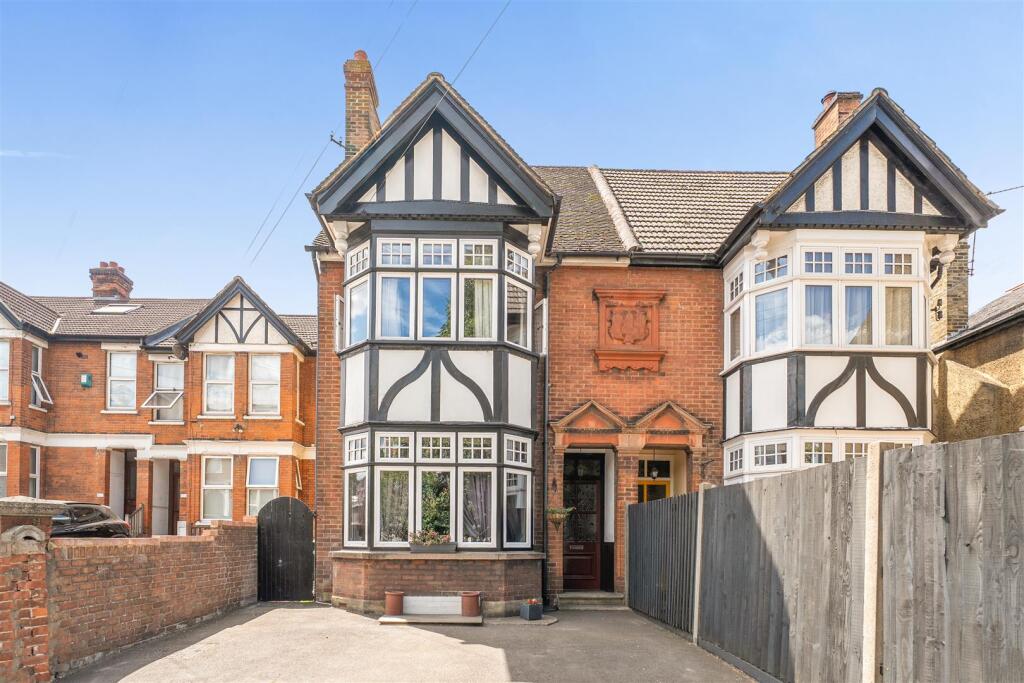
This is a four-bedroom Edwardian semi on Hayle Road in Maidstone that feels like it belongs in a different price bracket. Behind the period frontage are two reception rooms, a large kitchen and breakfast room, a separate utility, a cellar and around 100ft of landscaped garden, with off-street parking for two cars thrown in for good measure. It has kept plenty of its original character, including fireplaces, bay windows and high ceilings, while still feeling like somewhere you could actually live rather than spend every weekend worrying about. It is on the market for £450,000.

Events this week
🪕 7 - 14 Aug - Broadstairs Folk Week // Acclaimed folk festival takes over town by the sea. Various locations, Broadstairs. Tickets from £63.
🏳️🌈 Sat 8 Aug - Margate Pride // Seafront march followed by live music, DJs, drag and the Mx Margate pageant at Dreamland. Various locations, Margate. Free.
🎉 Sat 8 Aug - Herne Bay Carnival Day // Seafront carnival with live music, family activities and an evening fireworks display. Various locations, Herne Bay. Free.
🎉 Sat 8 Aug - Medway Culture Club Carnival // Family fun day celebrating diversity in the Medway community. Royal Engineers Museum, Gillingham. Free.
🎸 Sat 8 Aug - Little Storping in the Swuff present Hassle Olympics // Acclaimed Medway band plays show to mark release of second album. Medway Little Theatre, Rochester. Tickets £10.
🏎️ 8 - 9 Aug - Motors by the Moat // More than 600 classic and performance vehicles alongside stunt driving and jet-ski displays. Leeds Castle, Maidstone. Tickets from £34.50.
🌻 8 - 9 Aug - Great Comp Summer Show // Specialist plant nurseries, local crafts, food and live jazz across seven acres of gardens. Great Comp Garden, Platt. Tickets £10.50.
Footnotes
Have a Kent story you think we might be interested in? Get in touch via hello(at)kentcurrent(dot)news - We’re always happy to talk off the record in the first instance…
Follow us elsewhere: Facebook, Instagram, BlueSky, and now WhatsApp for new story alerts.